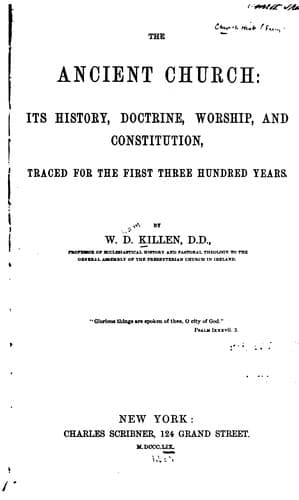
The Ancient Church: Its History, Doctrine, Worship, and ConstitutionKillen, W. D. (William Dool)
Religion
The Ancient Church: Its History, Doctrine, Worship, and Constitution
Killen, W. D. (William Dool)
Church history -- Primitive and early church, ca. 30-600
The influence of Christianity on the condition of the slave was soon
felt. The believing master was more humane than his pagan neighbour;
[325:5] his bearing was more gentle, conciliatory, and considerate; and
the domestics under his care were more comfortable. [325:6] There was a
disposition among pious slave-owners to let the oppressed go free, and
when they performed such an act of mercy, and both parties were in
communion with the Church, the congregation was assembled to witness the
consummation of the happy deliverance. [326:1] Thus, multitudes of
bondsmen in all parts of the Roman Empire were soon taught to regard the
gospel as their best benefactor.
Whilst Christianity, in the spirit of its Great Founder, was labouring
to improve the tone of public sentiment, and to undo heavy burdens, it
exhibited other most attractive characteristics. Wherever a disciple
travelled, if a church existed in the district, he felt himself at home.
The ecclesiastical certificate which he carried along with him, at once
introduced him to the meetings of his co-religionists, and secured for
him all the advantage of membership. The heathen were astonished at the
cordiality with which the believers among whom they resided greeted a
Christian stranger. He was saluted with the kiss of peace; ushered into
their assembly; and invited to share the hospitality of the domestic
board. If he was sick, they visited him; if he was in want, they made
provision for his necessities. The poor widows were supported at the
expense of the Church; and if any of the brethren were carried captive
by predatory bands of the barbarians who hovered upon the borders of the
Empire, contributions were made to purchase their liberation from
servitude. [326:2] To those who were without the Church, its members
appeared as one large and affectionate family. The pagan could not
comprehend what it was that so closely cemented their brotherhood; for
he did not understand how they could be attracted to each other by love
to a common Saviour. He was almost induced to believe that they held
intercourse by certain mysterious signs, and that they were affiliated
by something like the bond of freemasonry. Even statesmen observed with
uneasiness the spirit of fraternity which reigned among the Christians;
and, though the disciples could never be convicted of any political
designs, suspicions were often entertained that, after all, they might
form a secret association, on an extensive scale, which might one day
prove dangerous to the established government.
Public-domain text, read in full here on John Shaqi.
Reviews
Reviews
No reviews yet
Be the first to share your thoughts on this work.
Elsewhere in the archive
Join the Discussion
Join the discussion
Sign in to leave a comment or review.
Sign InorCreate an account