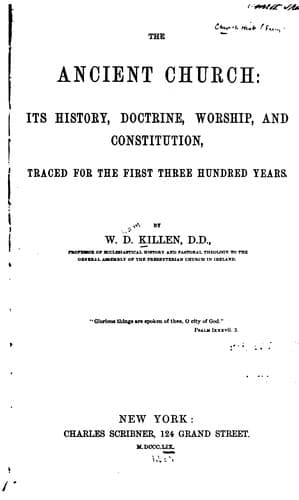
The Ancient Church: Its History, Doctrine, Worship, and ConstitutionKillen, W. D. (William Dool)
Religion
The Ancient Church: Its History, Doctrine, Worship, and Constitution
Killen, W. D. (William Dool)
Church history -- Primitive and early church, ca. 30-600
There is, indeed, a sense in which Peter may, perhaps, be said to have
founded the great Church of the West; for it is possible that some of
the "strangers of Rome," [330:3] who heard his celebrated sermon on the
day of Pentecost, were then converted by his ministry; and it may be
that these converts, on their return home, proceeded to disseminate the
truth, and to organize a Christian society, in the chief city of the
Empire. This, however, is mere matter of conjecture; and it is now
useless to speculate upon the subject; as, in the absence of historical
materials to furnish us with information, the question must remain
involved in impenetrable mystery. It is certain that the Roman Church
was established long before it was visited by an apostle; and it is
equally clear that its members were distinguished, at an early period,
by their Christian excellence. When Paul was prisoner for the first time
in the great city, he was freely permitted to exercise his ministry;
but, subsequently, when there during the Neronian persecution, he was,
according to the current tradition, seized and put to death. [330:4]
Peter's martyrdom took place, as we have seen, [330:5] perhaps about a
year afterwards; but the legend describing it contains very improbable
details, and the facts have obviously been distorted and exaggerated.
For at least seventy years after the death of the apostle of the
circumcision, nothing whatever is known of the history of the Roman
Church, except the names of some of its leading ministers. It was
originally governed, like other Christian communities, by the common
council of the presbyters, who, as a matter of order, must have had a
chairman; but though, about a hundred years after the martyrdom of
Peter, when the presidents began to be designated _bishops_, an attempt
was made to settle their order of succession, [331:1] the result was by
no means satisfactory. Some of the earliest writers who touch
incidentally upon the question are inconsistent with themselves; [331:2]
whilst they flatly contradict each other. [331:3] In fact, to this day,
what is called the episcopal succession in the ancient Church of Rome is
an historical riddle. At first no one individual seems to have acted for
life as the president, or moderator, of the presbytery; but as it was
well known that, at an early date, several eminent pastors had belonged
to it, the most distinguished names found their way into the catalogues,
and each writer appears to have consulted his own taste or judgment in
regulating the order of succession. Thus, it has probably occurred that
their lists are utterly irreconcileable. All such genealogies are,
indeed, of exceedingly dubious credit, and those who deem them of
importance must always be perplexed by the candid acknowledgment of the
father of ecclesiastical history. "How many," says he, "and who,
prompted by a kindred spirit, were judged fit to feed the churches
Public-domain text, read in full here on John Shaqi.
Reviews
Reviews
No reviews yet
Be the first to share your thoughts on this work.
Elsewhere in the archive
Join the Discussion
Join the discussion
Sign in to leave a comment or review.
Sign InorCreate an account