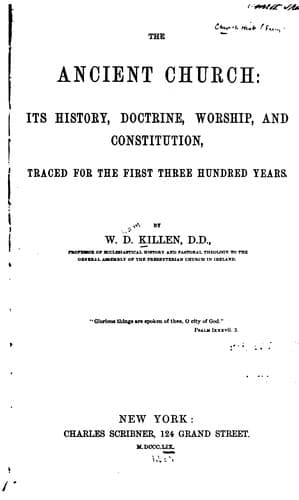
The Ancient Church: Its History, Doctrine, Worship, and ConstitutionKillen, W. D. (William Dool)
Religion
The Ancient Church: Its History, Doctrine, Worship, and Constitution
Killen, W. D. (William Dool)
Church history -- Primitive and early church, ca. 30-600
religion obviously fitted for all mankind. There had long since been a
prediction that its dominion should extend "from sea to sea and from the
river unto the ends of the earth;" and its progress already indicated
that the promise would receive a glorious accomplishment.
CHAPTER IV.
THE CHURCH OF ROME IN THE SECOND CENTURY.
The great doctrines of Christianity are built upon _the facts_ of the
life of our Lord. These facts are related by the four evangelists with
singular precision, and yet with a variety of statement, as to details,
which proves that each writer delivered an independent testimony. The
witnesses all agree when describing the wonderful history of the Captain
of our Salvation; and they dwell upon the narrative with a minuteness
apparently corresponding to the importance of the _doctrine_ which the
facts establish or illustrate. Hence it is that, whilst they scarcely
notice, or altogether omit, several items of our Saviour's biography,
they speak particularly of His birth and of His miracles, of His death
and of His resurrection. Thus, all the great facts of the gospel are
most amply authenticated.
It is not so with the system of Romanism; as nothing can be weaker than
the historical basis on which it rests. The New Testament demonstrates
that Peter was _not_ the Prince of the Apostles; for it records the
rebuke which our Lord delivered to the Twelve when they strove among
themselves "which of them should be accounted the greatest." [329:1] It
also supplies evidence that neither Peter nor Paul founded the Church of
Rome; as, before that Church had been visited by the Apostle of the
Gentiles, its faith was "spoken of throughout the whole world;" [329:2]
and the apostle of the circumcision was meanwhile labouring in another
part of the Empire. [330:1] When writing to the Romans in A.D. 57, Paul
greets many members of the Church, and mentions the names of a great
variety of individuals; [330:2] but, throughout his long epistle, Peter
is not once noticed. Had he been connected with that Christian
community, he would, beyond doubt, have been prominently recognised.
Public-domain text, read in full here on John Shaqi.
Reviews
Reviews
No reviews yet
Be the first to share your thoughts on this work.
Elsewhere in the archive
Join the Discussion
Join the discussion
Sign in to leave a comment or review.
Sign InorCreate an account