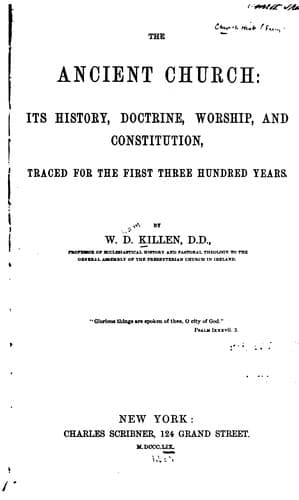
The Ancient Church: Its History, Doctrine, Worship, and ConstitutionKillen, W. D. (William Dool)
Religion
The Ancient Church: Its History, Doctrine, Worship, and Constitution
Killen, W. D. (William Dool)
Church history -- Primitive and early church, ca. 30-600
The term _Catholic_, which occurs for the first time in a document
written about this period, [337:5] was probably coined at Rome, and
implied, as already intimated, that the individual so designated was in
communion with the bishop. The presiding pastors in the great city began
now, in token of fraternity and recognition, to send the Eucharist to
their brethren elsewhere by trusty messengers, [337:6] and thus the name
was soon extended to all who maintained ecclesiastical relations with
these leading ministers. Sectaries were almost always the minority; and
in many places, where Christianity was planted, they were utterly
unknown. The orthodox might, therefore, not inappropriately be styled
members of the _Catholic_ or _general_ Church, inasmuch as they formed
the bulk of the Christian population, and were to be found wherever the
new religion had made converts. And though the heretics pleaded
tradition in support of their peculiar dogmas, it was clear that their
statements could not stand the test of examination. Irenaeus, in the
work from which the words just quoted are extracted, very fairly argues
that no such traditions as those propagated by the sectaries were to be
found in the most ancient and respectable Churches. No Christian
community in Western Europe could claim higher antiquity than that of
Rome; and as it had been taught by Paul and Peter, none could be
supposed to be better acquainted with the original gospel. Because of
its extent it already required a larger staff of ministers than perhaps
any other Church; and thus there were a greater number of individuals to
quicken and correct each other's recollections. It might be accordingly
inferred that the traditions of surrounding Christian societies, if
true, should correspond to those of Rome; as the great metropolitan
Church might, for various reasons, be said to be more potentially
primitive or apostolical, and as its traditions might be expected to be
particularly accurate. The doctrines of the heretics, which were
completely opposed to the testimony of this important witness, should be
discarded as entirely destitute of authority.
Public-domain text, read in full here on John Shaqi.
Reviews
Reviews
No reviews yet
Be the first to share your thoughts on this work.
Elsewhere in the archive
Join the Discussion
Join the discussion
Sign in to leave a comment or review.
Sign InorCreate an account