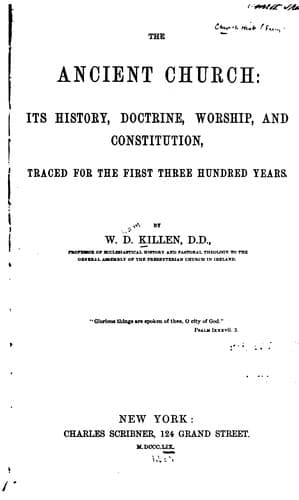
The Ancient Church: Its History, Doctrine, Worship, and ConstitutionKillen, W. D. (William Dool)
Religion
The Ancient Church: Its History, Doctrine, Worship, and Constitution
Killen, W. D. (William Dool)
Church history -- Primitive and early church, ca. 30-600
We can only conjecture the route by which Irenaeus travelled to the
south of France when he first set out from Asia Minor; but we have
direct evidence that he had paid a visit to the capital shortly before
he wrote this memorable eulogium on the Roman Church. About the close of
the dreadful persecution endured in A.D. 177 by the Christians of Lyons
and Vienne, he had been commissioned to repair to Italy with a view to a
settlement of the disputes created by the appearance of the Montanists.
As he was furnished with very complimentary credentials, [339:1] we may
presume that he was handsomely treated by his friends in the metropolis;
and if he returned home laden with presents to disciples whose
sufferings had recently so deeply moved the sympathy of their brethren,
it is not strange that he gracefully seized an opportunity of extolling
the Church to which he owed such obligations. His account of its
greatness is obviously the inflated language of a panegyrist; but in due
time its hyperbolic statements received a still more extravagant
interpretation; and, on the authority of this ancient father, the Church
of Rome was pompously announced as the mistress and the mother of all
Churches.
It has been mentioned in a former chapter [339:2] that the celebrated
Marcia who, until shortly before his death, possessed almost absolute
control over the Emperor Commodus, made a profession of the faith. Her
example, no doubt, encouraged other personages of distinction to connect
themselves with the Roman Church; and, through the medium of these
members of his flock, the bishop Eleutherius must have had an influence
such as none of his predecessors possessed. It is beyond doubt that
Marcia, after consulting with Victor, the successor of Eleutherius,
induced the Emperor to perform acts of kindness to some of her
co-religionists. [339:3] The favour of the court seems to have puffed up
the spirit of this naturally haughty churchman; and though, as we have
seen, there is cause to suspect that certain ecclesiastical movements in
the chief city had long before excited much ill-suppressed
dissatisfaction, the Christian commonwealth was now startled for the
first time by a very flagrant exhibition of the arrogance of a Roman
prelate. [340:1] Because the Churches of Asia Minor celebrated the
Paschal feast in a way different from that observed in the metropolis,
[340:2] Victor cut them off from his communion. But this attempt of the
bishop of the great city to act as lord over God's heritage was
premature. Other churches condemned the rashness of his procedure; his
refusal to hold fellowship with the Asiatic Christians threatened only
to isolate himself; and he seems to have soon found it expedient to
cultivate more pacific councils.
Public-domain text, read in full here on John Shaqi.
Reviews
Reviews
No reviews yet
Be the first to share your thoughts on this work.
Elsewhere in the archive
Join the Discussion
Join the discussion
Sign in to leave a comment or review.
Sign InorCreate an account