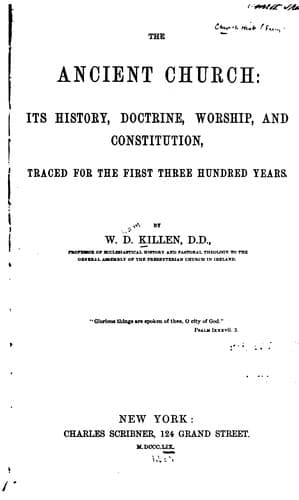
The Ancient Church: Its History, Doctrine, Worship, and ConstitutionKillen, W. D. (William Dool)
Religion
The Ancient Church: Its History, Doctrine, Worship, and Constitution
Killen, W. D. (William Dool)
Church history -- Primitive and early church, ca. 30-600
In A.D. 1551, as some workmen in the neighbourhood of Rome were employed
in clearing away the ruins of a dilapidated chapel, they found a broken
mass of sculptured marble among the rubbish. The fragments, when put
together, proved to be a statue representing a person of venerable
aspect sitting in a chair, on the back of which were the names of
various publications. It was ascertained, on more minute examination,
that, some time after the establishment of Christianity by Constantine,
[344:1] this monument had been erected in honour of Hippolytus--a
learned writer and able controversialist, who bad been bishop of Portus
in the early part of the third century, and who had finished his career
by martyrdom, about A.D. 236, during the persecution under the Emperor
Maximin. Hippolytus is commemorated as a saint in the Romish Breviary;
[344:2] and the resurrection of his statue, after it had been buried for
perhaps a thousand years, created quite a sensation among his papal
admirers. Experienced sculptors, under the auspices of the Pontiff, Pius
IV., restored the fragments to nearly their previous condition; and the
renovated statue was then duly honoured with a place in the Library of
the Vatican.
Nearly three hundred years afterwards, or in 1842, a manuscript which
had been found in a Greek monastery at Mount Athos, was deposited in the
Royal Library at Paris. This work, which has been since published,
[345:1] and which is entitled "Philosophumena, or a Refutation of all
Heresies," has been identified as the production of Hippolytus. It does
not appear in the list of his writings mentioned on the back of the
marble chair; but any one who inspects its contents can satisfactorily
account for its exclusion from that catalogue. It reflects strongly on
the character and principles of some of the early Roman bishops; and as
the Papal see was fast rising into power when the statue was erected, it
was obviously deemed prudent to omit an invidious publication. The
writer of the "Philosophumena" declares that he is the author of one of
the books named on that piece of ancient sculpture, and various other
facts amply corroborate his testimony. There is, therefore, no good
reason to doubt that a Christian bishop who lived about fifteen miles
from Rome, and who flourished little more than one hundred years after
the death of the Apostle John, composed the newly discovered Treatise.
[345:2]
Public-domain text, read in full here on John Shaqi.
Reviews
Reviews
No reviews yet
Be the first to share your thoughts on this work.
Elsewhere in the archive
Join the Discussion
Join the discussion
Sign in to leave a comment or review.
Sign InorCreate an account