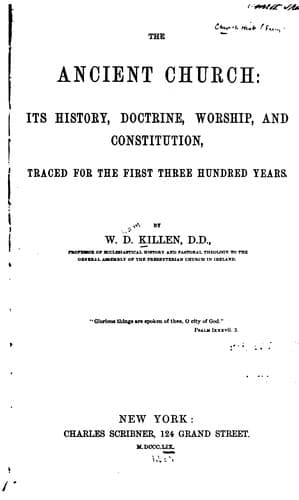
The Ancient Church: Its History, Doctrine, Worship, and ConstitutionKillen, W. D. (William Dool)
Religion
The Ancient Church: Its History, Doctrine, Worship, and Constitution
Killen, W. D. (William Dool)
Church history -- Primitive and early church, ca. 30-600
Prelacy had been employed as the cure for Church divisions, but the
remedy had proved worse than the disease. Sects meanwhile continued to
multiply; and they were, perhaps, nowhere so abundant as in the very
city where the new machinery had been first set up for their
suppression. Towards the close of the second century their multitude was
one of the standing reproaches of Christianity. What was called the
Catholic Church was now on the brink of a great schism; and the very
man, who aspired to be the centre of Catholic unity, threatened to be
the cause of the disruption. It was becoming more and more apparent
that, when the presbyters consented to surrender any portion of their
privileges to the bishop, they betrayed the cause of ecclesiastical
freedom; and even now indications were not wanting that the Catholic
system was likely to degenerate into a spiritual despotism.
CHAPTER V.
THE CHURCH OF ROME IN THE THIRD CENTURY.
Though very few of the genuine productions of the ministers of the
ancient Church of Rome are still extant, [343:1] multitudes of spurious
epistles attributed to its early bishops have been carefully preserved.
It is easy to account for this apparent anomaly. The documents now known
as the false Decretals, [343:2] and ascribed to the Popes of the first
and immediately succeeding centuries, were suited to the taste of times
of ignorance, and were then peculiarly grateful to the occupants of the
Roman see. As evidences of its original superiority they were
accordingly transmitted to posterity, and ostentatiously exhibited among
the papal title-deeds. But the real compositions of the primitive
pastors of the great city supplied little food for superstition; and
must have contained startling and humiliating revelations which laid
bare the absurdity of claims subsequently advanced. These unwelcome
witnesses were, therefore, quietly permitted to pass into oblivion.
It has been said, however, that Truth is the daughter of Time, and the
discovery of monuments long since forgotten, or of writings supposed to
have been lost, has often wonderfully verified and illustrated the
apologue. The reappearance, within the last three hundred years, of
various ancient records and memorials, has shed a new light upon the
history of antiquity. Other testimonies equally valuable will, no doubt,
yet be forthcoming for the settlement of existing controversies.
Public-domain text, read in full here on John Shaqi.
Reviews
Reviews
No reviews yet
Be the first to share your thoughts on this work.
Elsewhere in the archive
Join the Discussion
Join the discussion
Sign in to leave a comment or review.
Sign InorCreate an account