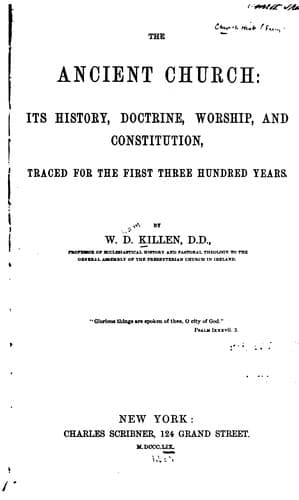
The Ancient Church: Its History, Doctrine, Worship, and ConstitutionKillen, W. D. (William Dool)
Religion
The Ancient Church: Its History, Doctrine, Worship, and Constitution
Killen, W. D. (William Dool)
Church history -- Primitive and early church, ca. 30-600
Though Callistus, as well as Hippolytus, is recognised as a saint in the
Romish Breviary, [348:2] it is thus certain that the bishop of Portus
regarded the bishop of Rome as a schemer and a heretic. It is equally
clear that, at this period, all bishops were on a level of equality, for
Hippolytus, though the pastor of a town in the neighbourhood of the
chief city, did not acknowledge Callistus as his metropolitan. The
bishop of Portus describes himself as one of those who are "successors
of the apostles, partakers with them of the same grace both of principal
priesthood and doctorship, and reckoned among the guardians of the
Church." [348:3] Hippolytus testifies that Callistus was afraid of him,
[348:4] and if both were members of the same synod, [348:5] well might
the heterodox prelate stand in awe of a minister who possessed
co-ordinate authority, with greater honesty and superior erudition. But
still, it is abundantly plain, from the admissions of the
"Philosophumena," that the bishop of Rome, in the time of the author of
this treatise, was beginning to presume upon his position. Hippolytus
complains of his irregularity in receiving into his communion some who
had been "cast out of the Church" of Portus "after judicial sentence."
[348:6] Had the bishop of the harbour of Rome been subject to the bishop
of the capital, he would neither have expressed himself in such a style,
nor preferred such an accusation.
Various circumstances indicate, as has already been suggested, that the
bishop of Rome, in the time of the Antonines, was chosen by lot; but we
may infer from the "Philosophumena" that, early in the third century,
another mode of appointment had been adopted. [349:1] It is obvious that
he now owed his advancement to the suffrages of the Church members, for
Hippolytus hints very broadly that Callistus pursued a particular course
with a view to promote his popularity and secure his election. It is
beyond doubt that, about A.D. 236, Fabian was chosen bishop of Rome by
the votes of the whole brotherhood, and there is on record a minute
account of certain extraordinary circumstances which signalised the
occasion. "When all the brethren had assembled in the church for the
purpose of choosing their future bishop, and when the names of many
worthy and distinguished men had suggested themselves to the
consideration of the multitude, no one so much as thought of Fabian who
was then present. They relate, however, that a dove gliding down from
the roof, straightway settled on his head, as when the Holy Spirit, like
a dove, rested upon the head of our Saviour. On this, the whole people,
as if animated by one divine impulse, with great eagerness, and with the
utmost unanimity, exclaimed that he was worthy; and, taking hold of him,
placed him forthwith on the bishop's chair." [349:2]
Public-domain text, read in full here on John Shaqi.
Reviews
Reviews
No reviews yet
Be the first to share your thoughts on this work.
Elsewhere in the archive
Join the Discussion
Join the discussion
Sign in to leave a comment or review.
Sign InorCreate an account