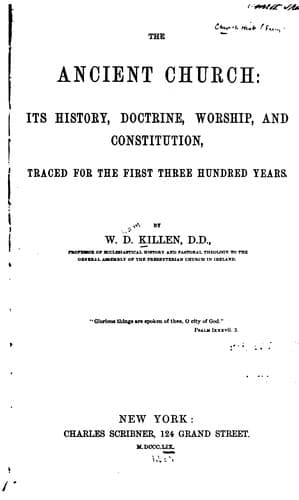
The Ancient Church: Its History, Doctrine, Worship, and ConstitutionKillen, W. D. (William Dool)
Religion
The Ancient Church: Its History, Doctrine, Worship, and Constitution
Killen, W. D. (William Dool)
Church history -- Primitive and early church, ca. 30-600
Justin, even after his conversion, still wore the philosopher's cloak,
and continued to cherish an undue regard for the wisdom of the pagan
sages. His mind never was completely emancipated from the influence of a
system of false metaphysics; and thus it was that, whilst his views of
various doctrines of the gospel remained confused, his allusions to them
are equivocal, if not contradictory. But it has been well remarked that
_conscience_, rather than _science_, guided many of the fathers; and the
case of Justin demonstrates the truth of the observation. He possessed
an extensive knowledge of the Scriptures; and though his theological
views were not so exact or so perspicuous as they might have been, had
he been trained up from infancy in the Christian faith, or had he
studied the controversies which subsequently arose, it is beyond doubt
that his creed was substantially evangelical. He had received the truth
"in the love of it," and he counted not his life dear in the service of
his Divine Master.
The _Epistle to Diognetus_, frequently included amongst the works of
Justin, is apparently the production of an earlier writer. Its author,
who styles himself "a disciple of apostles," designed by it to promote
the conversion of a friend; his own views of divine truth are
comparatively correct and clear; and in no uninspired memorial of
antiquity are the peculiar doctrines of the gospel exhibited with
greater propriety and beauty. Appended also to the common editions of
the works of Justin are the remains of a few somewhat later writers,
namely, Tatian, Athenagoras, Theophilus, and Hernias. Tatian was a
disciple of Justin; [367:1] Athenagoras was a learned man of Athens;
Theophilus is said to have been one of the pastors of Antioch; and of
Hermas nothing whatever is known. The tracts of these authors relate
almost entirely to the controversy between Christianity and Paganism.
Whilst they point out the folly and falsehood of the accusations so
frequently preferred against the brethren, they press the gospel upon
the acceptance of the Gentiles with much earnestness, and support its
claims by a great variety of arguments.
The tract known as the _Epistle of Barnabas_ was probably composed in
A.D.135. [367:2] It is the production apparently of a convert from
Judaism who took special pleasure in allegorical interpretations of
Scripture. Hermas, the author of the little work called _Pastor_, or The
Shepherd, is a writer of much the same character. He was, in all
likelihood, the brother of Pius, [368:1] who flourished about the middle
of the second century, and who was, perhaps, the first or second
individual who was officially designated Bishop of Rome. The writings of
Papias, said to have been pastor of Hierapolis in the time of Polycarp,
are no longer extant. [368:2] The works of Hegesippus, of a somewhat
later date, and treating of the subject of ecclesiastical history, have
also disappeared. [368:3]
Public-domain text, read in full here on John Shaqi.
Reviews
Reviews
No reviews yet
Be the first to share your thoughts on this work.
Elsewhere in the archive
Join the Discussion
Join the discussion
Sign in to leave a comment or review.
Sign InorCreate an account