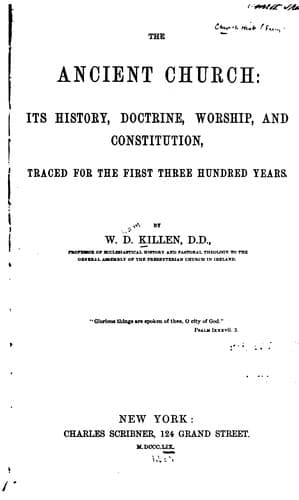
The Ancient Church: Its History, Doctrine, Worship, and ConstitutionKillen, W. D. (William Dool)
Religion
The Ancient Church: Its History, Doctrine, Worship, and Constitution
Killen, W. D. (William Dool)
Church history -- Primitive and early church, ca. 30-600
_Irenaeus_ of Lyons is the next writer who claims our special notice. He
was originally connected with Asia Minor; and in his youth he is said to
have enjoyed the tuition of Polycarp of Smyrna. We cannot tell when he
left his native country, or what circumstances led him to settle on the
banks of the Rhone; but we know that, towards the termination of the
reign of Marcus Aurelius, he was appointed by the Gallic Christians to
visit the Roman Church on a mission of importance. The Celtic language,
still preserved in the Gaelic or Irish, was then spoken in France,
[368:4] and Irenaeus found it necessary to qualify himself for the
duties of a preacher among the heathen by studying the barbarous
dialect. His zeal, energy, and talent were duly appreciated; soon after
the death of the aged Pothinus he became the chief pastor of Lyons; and
for many years he exercised considerable influence throughout the whole
of the Western Church. When the Paschal controversy created such
excitement, and when Victor of Rome threatened to rend the Christian
commonwealth by his impetuous and haughty bearing, Irenaeus interposed,
and to some extent succeeded in moderating the violence of the Italian
prelate. He was the author of several works, [369:1] but his only extant
production is a treatise "Against Heresies." It is divided into five
books, four of which exist only in a Latin version; [369:2] and it
contains a lengthened refutation of the Valentinians and other Gnostics.
Irenaeus is commonly called the disciple of Polycarp; but it is reported
that he was also under the tuition of a less intelligent preceptor,
Papias of Hierapolis. [369:3] This teacher, who has been already
mentioned, and who was the author of a work now lost, entitled, "The
Explanations of the Discourses of the Lord," is noted as the earliest
ecclesiastical writer who held the doctrine of the personal reign of
Christ at Jerusalem during the millennium. "These views," says Eusebius,
"he appears to have adopted in consequence of having misunderstood the
apostolic narratives.... For he was a man of very slender intellect, as
is evident from his discourses." [369:4] His pupil Irenaeus possessed a
much superior capacity; but even his writings are not destitute of
puerilities; and it is not improbable that he derived some of the errors
to be found in them from his weak-minded teacher. [369:5]
Public-domain text, read in full here on John Shaqi.
Reviews
Reviews
No reviews yet
Be the first to share your thoughts on this work.
Elsewhere in the archive
Join the Discussion
Join the discussion
Sign in to leave a comment or review.
Sign InorCreate an account