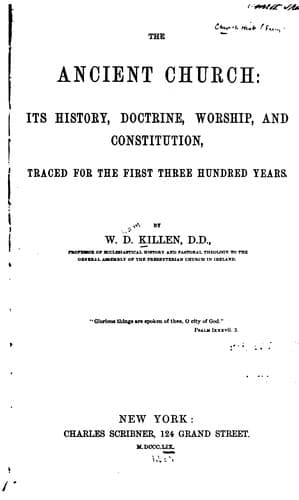
The Ancient Church: Its History, Doctrine, Worship, and ConstitutionKillen, W. D. (William Dool)
Religion
The Ancient Church: Its History, Doctrine, Worship, and Constitution
Killen, W. D. (William Dool)
Church history -- Primitive and early church, ca. 30-600
The Roman Empire in the time of Augustus presents to the eye of
contemplation a most interesting spectacle, whether we survey its
territorial magnitude, its political power, or its intellectual
activity. But when we look more minutely at its condition, we may
discover many other strongly marked and less inviting features. That
stern patriotism, which imparted so much dignity to the old Roman
character, had now disappeared, and its place was occupied by ambition
or covetousness. Venality reigned throughout every department of the
public administration. Those domestic virtues, which are at once the
ornaments and the strength of the community, were comparatively rare;
and the prevalence of luxury and licentiousness proclaimed the unsafe
state of the social fabric. There was a growing disposition to evade the
responsibilities of marriage, and a large portion of the citizens of
Rome deliberately preferred the system of concubinage to the state of
wedlock. The civil wars, which had created such confusion and involved
such bloodshed, had passed away; but the peace which followed was,
rather the quietude of exhaustion, than the repose of contentment.
The state of the Roman Empire about the time of the birth of Christ
abundantly proves that there is no necessary connexion between
intellectual refinement and social regeneration. The cultivation of the
arts and sciences in the reign of Augustus may have been beneficial to a
few, by diverting them from the pursuit of vulgar pleasures, and opening
up to them sources of more rational enjoyment; but it is a most
humiliating fact that, during the brightest period in the history of
Roman literature, vice in every form was fast gaining ground among
almost all classes of the population. The Greeks, though occupying a
higher position as to mental accomplishments, were still more dissolute
than the Latins. Among them literature and sensuality appeared in
revolting combination, for their courtesans were their only females who
attended to the culture of the intellect. [7:1]
Public-domain text, read in full here on John Shaqi.
Reviews
Reviews
No reviews yet
Be the first to share your thoughts on this work.
Join the Discussion
Join the discussion
Sign in to leave a comment or review.
Sign InorCreate an account