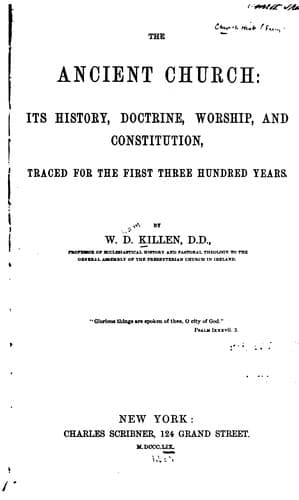
The Ancient Church: Its History, Doctrine, Worship, and ConstitutionKillen, W. D. (William Dool)
Religion
The Ancient Church: Its History, Doctrine, Worship, and Constitution
Killen, W. D. (William Dool)
Church history -- Primitive and early church, ca. 30-600
Tertullian is commonly known as the earliest of the Latin fathers.
[371:2] The writer who first attempted to supply the rulers of the world
with a Christian literature in their own tongue encountered a task of
much difficulty. It was no easy matter to conduct theological
controversies in a language which was not remarkable for flexibility,
and which had never before been employed in such discussions; and
Tertullian seems to have often found it necessary to coin unwonted forms
of expression, or rather to invent an ecclesiastical nomenclature. The
ponderous Latin, hitherto accustomed to speak only of Jupiter and the
gods, engages somewhat awkwardly in its new vocation; and yet contrives
to proclaim, with wonderful power, the great thoughts for which it must
now find utterance. Several years after his appearance as an author,
Tertullian lapsed into Montanism--a species of heresy peculiarly
attractive to a man of his rugged and austere character. Some of his
works bear clear traces of this change of sentiment; but others furnish
no internal evidences warranting us to pronounce decisively respecting
the date of their composition. It is remarkable that though he
identified himself with a party under the ban of ecclesiastical
proscription, his works still continued to be held in high repute, and
to be perused with avidity by those who valued themselves on their zeal
for orthodoxy. It is recorded of one of the most influential of the
Catholic bishops of the third century that he read a portion of them
daily; and, when calling for his favourite author, he is reported to
have said--"Give me _the Master_." [372:1]
Tertullian flourished at a period when ecclesiastical usurpation was
beginning to produce some of its bitter fruits, and when religion was
rapidly degenerating from its primitive purity. [372:2] His works, which
treat of a great variety of topics interesting to the Christian student,
throw immense light on the state of the Church in his generation. His
best known production is his _Apology_, in which he pleads the cause of
the persecuted disciples with consummate talent, and urges upon the
state the equity and the wisdom of toleration. He expounds the doctrine
of the Trinity more lucidly than any preceding writer; he treats of
Prayer, of Repentance, and of Baptism; he takes up the controversy with
the Jews; [372:3] and he assails the Valentinians and other heretics.
But the way of salvation by faith seems to have been very indistinctly
apprehended by him, so that he cannot be safely trusted as a theologian.
He had evidently no clear conception of the place which works ought to
occupy according to the scheme of the gospel; and hence he sometimes
speaks as if pardon could be purchased by penance, by fasting, or by
martyrdom.
Public-domain text, read in full here on John Shaqi.
Reviews
Reviews
No reviews yet
Be the first to share your thoughts on this work.
Elsewhere in the archive
Join the Discussion
Join the discussion
Sign in to leave a comment or review.
Sign InorCreate an account