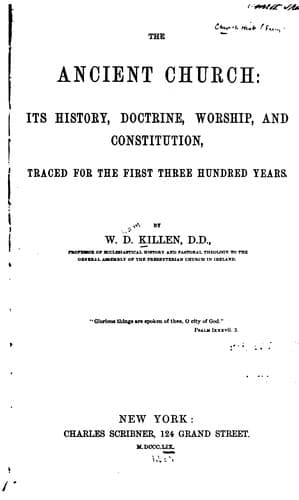
The Ancient Church: Its History, Doctrine, Worship, and ConstitutionKillen, W. D. (William Dool)
Religion
The Ancient Church: Its History, Doctrine, Worship, and Constitution
Killen, W. D. (William Dool)
Church history -- Primitive and early church, ca. 30-600
_Clement of Alexandria_ was contemporary with Tertullian. Like him, he
was a Gentile by birth; but we know nothing of the circumstances
connected with his conversion. In early times Alexandria was one of the
great marts of literature and science; its citizens were noted for their
intellectual culture; and, when a Church was formed there, learned men
began to pass over to the new religion in considerable numbers. It was,
in consequence, deemed expedient to establish an institute where
catechumens of this class, before admission to baptism, could be
instructed in the faith by some well qualified teacher. The plan of the
seminary seems to have been gradually enlarged; and it soon supplied
education to candidates for the ministry. Towards the close of the
second century, Pantaenus, a distinguished scholar, had the charge of
it; and Clement, who had been his pupil, became his successor as its
president. Some of the works of this writer have perished, and his only
extant productions are a discourse entitled "What rich man shall be
saved?" his Address to the Greeks or Gentiles, his Paedagogue, and his
Stromata. The hortatory Address is designed to win over the pagans from
idolatry; the Paedagogue directs to Jesus, or the Word, as the great
Teacher, and supplies converts with practical precepts for their
guidance; whilst in the Stromata, or Miscellanies, we have a description
of what he calls the Gnostic or perfect Christian. He here takes
occasion to attack those who, in his estimation, were improperly
designated Gnostics, such as Basilides, Valentine, Marcion, and others.
Clement, as is apparent from his writings, was extensively acquainted
with profane literature. But he formed quite too high an estimate of the
value of the heathen philosophy, whilst he allegorized Scripture in a
way as dangerous as it was absurd. By the serpent which deceived Eve,
according to Clement, "_pleasure_, an earthly vice which creeps upon the
belly, is allegorically represented." [374:1] Moses, speaking
allegorically, if we may believe this writer, called the Divine Wisdom
_the tree of life_ planted in paradise; by which paradise we may
understand the world, in which all the works of creation were called
into being. [374:2] He even interprets the ten commandments
allegorically. Thus, by _adultery_, he understands a departure from the
true knowledge of the Most High, and by _murder_, a violation of the
truth respecting God and His eternal existence. [374:3] It is easy to
see how Scripture, by such a system of interpretation, might be tortured
into a witness for any extravagance.
Public-domain text, read in full here on John Shaqi.
Reviews
Reviews
No reviews yet
Be the first to share your thoughts on this work.
Elsewhere in the archive
Join the Discussion
Join the discussion
Sign in to leave a comment or review.
Sign InorCreate an account