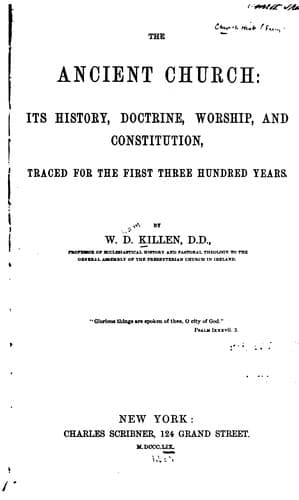
The Ancient Church: Its History, Doctrine, Worship, and ConstitutionKillen, W. D. (William Dool)
Religion
The Ancient Church: Its History, Doctrine, Worship, and Constitution
Killen, W. D. (William Dool)
Church history -- Primitive and early church, ca. 30-600
This great man throughout life practised extraordinary self-denial. His
clothing was scarcely sufficient to protect him from the cold; he slept
on the ground; he confined himself to the simplest fare; and for years
he persisted in going barefoot. [377:2] But his austerities did not
prevent him from acquiring a world-wide reputation. Pagan philosophers
attended his lectures, and persons of the highest distinction sought his
society. When Julia Mammaea, the mother of Alexander Severus, invited
him to visit her, and when, in compliance with this summons, he
proceeded to Antioch [377:3] escorted by a military guard, he must have
been an object of no little curiosity to the Imperial courtiers. It
could now no longer be said that the Christians were an illiterate
generation; as, in all that brilliant throng surrounding the throne of
the Master of the Roman world, there was not, perhaps, one to be
compared, with the poor catechist of Alexandria for varied and profound
scholarship. But his theological taste was sadly vitiated by his study
of the pagan philosophy. Clement, his early instructor, led him to
entertain far too high an opinion of its excellence; and a subsequent
teacher, Ammonius Saccas, the father of New Platonism, thoroughly imbued
his mind with many of his own dangerous principles. According to
Ammonius all systems of religion and philosophy contain the elements of
truth; and it is the duty of the wise man to trace out and exhibit their
harmony. The doctrines of Plato formed the basis of his creed, and it
required no little ingenuity, to shew how all other theories quadrated
with the speculations of the Athenian sage. To establish his views, he
was obliged to draw much on his imagination, and to adopt modes of
exegesis the most extravagant and unwarrantable. The philosophy of
Ammonius exerted a very pernicious influence upon Origen, and seduced
him into not a few of those errors which have contributed so greatly to
lower his repute as a theologian.
Public-domain text, read in full here on John Shaqi.
Reviews
Reviews
No reviews yet
Be the first to share your thoughts on this work.
Elsewhere in the archive
Join the Discussion
Join the discussion
Sign in to leave a comment or review.
Sign InorCreate an account