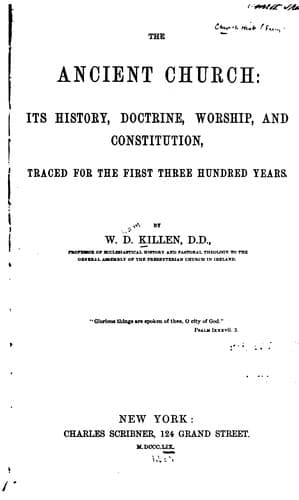
The Ancient Church: Its History, Doctrine, Worship, and ConstitutionKillen, W. D. (William Dool)
Religion
The Ancient Church: Its History, Doctrine, Worship, and Constitution
Killen, W. D. (William Dool)
Church history -- Primitive and early church, ca. 30-600
Origen was a most prolific author; and, if all his works were still
extant, they would be far more voluminous than those of any other of the
fathers. But most of his writings have been lost; and, in not a few
instances, those which remain have reached us either in a very mutilated
form, or in a garbled Latin version. His treatise "Against Celsus,"
which was composed when he was advanced in life, and which is by far the
most valuable of his existing works, has come down to us in a more
perfect state than, perhaps, any of his other productions. It is a
defence of Christianity in reply to the publication of a witty heathen
philosopher who wrote against it in the time of the Antonines. [378:1]
Of his celebrated "Hexapla," to which he is said to have devoted much of
his time for eight and twenty years, only some fragments have been
preserved. This great work appears to have been undertaken to meet the
cavils of the Jews against the Septuagint--the Greek translation of the
Old Testament in current use in the days of the apostles, and still most
appreciated by the Christians. The unbelieving Israelites now pronounced
it a corrupt version; and, that all might have an opportunity of judging
for themselves, Origen exhibited the text in six consecutive
columns--the first, containing the original Hebrew--the second, the same
in Greek letters--and the third, fourth, fifth, and sixth, four of the
most famous of the Greek translations, including the Septuagint. [379:1]
The labour employed in the collation of manuscripts, when preparing this
work, was truly prodigious. The expense, which must also have been
great, is said to have been defrayed by Ambrosius, a wealthy Christian
friend, who placed at the disposal of the editor the constant services
of seven amanuenses. By his "Hexapla" Origen did much to preserve the
purity of the sacred text, and he may be said to have thus laid the
foundations of the science of Scripture criticism.
This learned writer cannot be trusted as an interpreter of the inspired
oracles. Like the Jewish Cabbalists, of whom Philo, whose works he had
diligently studied, [379:2] is a remarkable specimen, he neglects the
literal sense of the Word, and betakes himself to mystical expositions.
[379:3] In this way the divine record may be made to support any
crotchet which happens to please the fancy of the commentator. Origen
may, in fact, be regarded as the father of Christian mysticism; and, in
after-ages, to a certain class of visionaries, especially amongst the
monks, his writings long continued to present peculiar attractions.
Public-domain text, read in full here on John Shaqi.
Reviews
Reviews
No reviews yet
Be the first to share your thoughts on this work.
Elsewhere in the archive
Join the Discussion
Join the discussion
Sign in to leave a comment or review.
Sign InorCreate an account