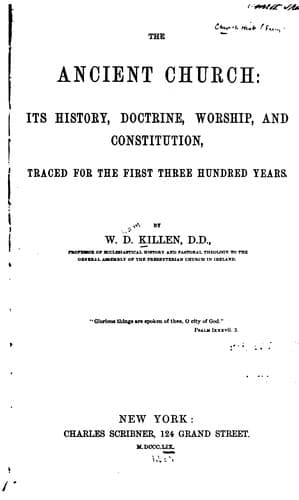
The Ancient Church: Its History, Doctrine, Worship, and ConstitutionKillen, W. D. (William Dool)
Religion
The Ancient Church: Its History, Doctrine, Worship, and Constitution
Killen, W. D. (William Dool)
Church history -- Primitive and early church, ca. 30-600
Nothing can be more unsatisfactory, or rather childish, than the
explanations of Holy Writ sometimes given by these ancient expositors.
According to Tertullian, the two sparrows mentioned in the New Testament
[383:2] signify the soul and the body; [383:3] and Clemens Alexandrinus
gravely pleads for marriage [383:4] from the promise-"Where two or three
are gathered together in my name, there am I in the midst of them."
[383:5] Cyprian produces, as an argument in support of the doctrine of
the Trinity, that the Jews observed "the third, sixth, and ninth hours"
as their "fixed and lawful seasons for prayer." [383:6] Origen
represents the heavenly bodies as literally engaged in acts of devotion.
[386:1] If these authorities are to be credited, the Gihon, one of the
rivers of Paradise, was no other than the Nile. [386:2] Very few of the
fathers of this period were acquainted with Hebrew, so that, as a class,
they were miserably qualified for the interpretation of the Scriptures.
Even Origen himself must have had a very imperfect knowledge of the
language of the Old Testament. [386:3] In consequence of their literary
deficiencies, the fathers of the second and third centuries occasionally
commit the most ridiculous blunders. Thus, Irenaeus tells us that the
name Jesus in Hebrew consists of two letters and a half, and describes
it as signifying "that Lord who contains heaven and earth!" [386:4] This
father asserts also that the Hebrew word _Adonai_, or the Lord, denotes
"utterable and wonderful." [386:5] Clemens Alexandrinus is not more
successful as an interpreter of the sacred tongue of the chosen people;
for he asserts that Jacob was called _Israel_ "because he had seen the
Lord God," [386:6] and he avers that _Abraham_ means "the elect father
of a sound!" [386:7] Justin Martyr errs egregiously in his references to
the Old Testament; as he cites Isaiah for Jeremiah, [386:8] Zechariah
for Malachi, [386:9] Zephaniah for Zechariah, [386:10] and Jeremiah for
Daniel. [386:11] Irenaeus repeats, as an apostolic tradition, that when
our Lord acted as a public teacher He was between forty and fifty years
of age; [387:1] and Tertullian affirms that He was about thirty years of
age at the time of His crucifixion. [387:2] The opinion of this same
writer in reference to angels is still more extraordinary. He maintains
that some of these beings, captivated by the beauty of the daughters of
men, came down from heaven and married them; and that, out of
complaisance to their brides, they communicated to them the arts of
polishing and setting precious stones, of preparing cosmetics, and of
using other appliances which minister to female vanity. [387:3] His
ideas upon topics of a different character are equally singular. Thus,
he affirms that the soul is corporeal, having length, breadth, height,
and figure. [387:4] He even goes so far as to say that there is no
substance which is not corporeal, and that God himself is a body.
[387:5]
Public-domain text, read in full here on John Shaqi.
Reviews
Reviews
No reviews yet
Be the first to share your thoughts on this work.
Elsewhere in the archive
Join the Discussion
Join the discussion
Sign in to leave a comment or review.
Sign InorCreate an account