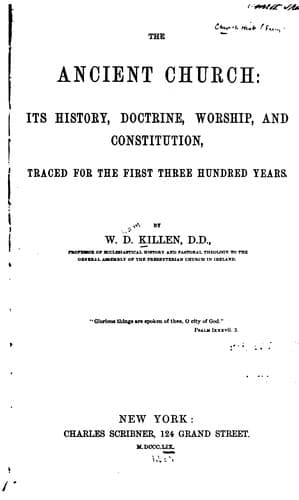
The Ancient Church: Its History, Doctrine, Worship, and ConstitutionKillen, W. D. (William Dool)
Religion
The Ancient Church: Its History, Doctrine, Worship, and Constitution
Killen, W. D. (William Dool)
Church history -- Primitive and early church, ca. 30-600
The preceding account of the fathers of the second and third centuries
may enable us to form some idea of the value of these writers as
ecclesiastical authorities. Most of them had reached maturity before
they embraced the faith of the gospel, so that, with a few exceptions,
they wanted the advantages of an early Christian education. Some of
them, before their conversion, had bestowed much time and attention on
the barren speculations of the pagan philosophers; and, after their
reception into the bosom of the Church, they still continued to pursue
the same unprofitable studies. Cyprian, one of the most eloquent of
these fathers, had been baptized only about two years before he was
elected bishop of Carthage; and, during his comparatively short
episcopate, he was generally in a turmoil of excitement, and had,
consequently, little leisure for reading or mental cultivation. Such a
writer is not entitled to command confidence as an expositor of the
faith once delivered to the saints. Even in our own day, with all the
facilities supplied by printing for the rapid accumulation of knowledge,
no one would expect much spiritual instruction from an author who would
undertake the office of an interpreter of Scripture two years after his
conversion from heathenism. The fathers of the second and third
centuries were not regarded as safe guides even by their Christian
contemporaries. Tatian was the founder of a sect of extreme
Teetotallers. [383:1] Tertullian, who, in point of learning, vigour, and
genius, stands at the head of the Latin writers of this period, was
connected with a party of gloomy fanatics. Origen, the most voluminous
and erudite of the Greek fathers, was excommunicated as a heretic. If we
estimate these authors, as they were appreciated by the early Church of
Rome, we must pronounce their writings of little value. Tertullian, as a
Montanist, was under the ban of the Roman bishop. Hippolytus could not
have been a favourite with either Zephyrinus or Callistus, for he
denounced both as heretics. Origen was treated by the Roman Church as a
man under sentence of excommunication. Stephen deemed even Cyprian
unworthy of his ecclesiastical fellowship, because the Carthaginian
prelate maintained the propriety of rebaptizing heretics.
Public-domain text, read in full here on John Shaqi.
Reviews
Reviews
No reviews yet
Be the first to share your thoughts on this work.
Elsewhere in the archive
Join the Discussion
Join the discussion
Sign in to leave a comment or review.
Sign InorCreate an account