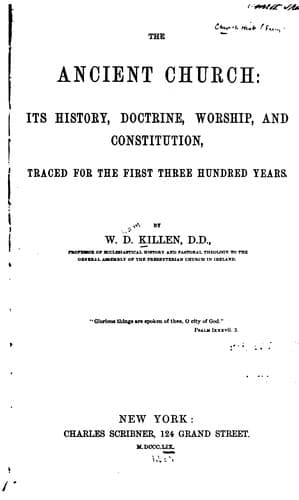
The Ancient Church: Its History, Doctrine, Worship, and ConstitutionKillen, W. D. (William Dool)
Religion
The Ancient Church: Its History, Doctrine, Worship, and Constitution
Killen, W. D. (William Dool)
Church history -- Primitive and early church, ca. 30-600
The Ignatian letters owe almost all their importance to the circumstance
that they are alleged to have been written on the confines of the
apostolic age. As very few records remain to illustrate the
ecclesiastical history of that period, it is not strange that epistles,
purporting to have emanated from one of the most distinguished ministers
who then flourished, should have excited uncommon attention. But doubts
regarding their genuineness have always been entertained by candid and
competent scholars. The spirit of sectarianism has entered largely into
the discussion of their claims; and, whilst certain distinct references
to the subject of Church polity, which they contain, have greatly
enhanced their value in the estimation of one party, the same passages
have been quoted, by those who repudiate their authority, as so many
decisive proofs of their fabrication. The annals of literature furnish,
perhaps, scarcely any other case in which ecclesiastical prejudices have
been so much mixed up with a question of mere criticism.
The history of the individual to whom these letters have been ascribed,
has been so metamorphosed by fables, that it is now, perhaps, impossible
to ascertain its true outlines. There is a tradition that he was the
child whom our Saviour set in the midst of His disciples as a pattern of
humility; [390:2] and as our Lord, on the occasion, took up the little
personage in His arms, it has been asserted that Ignatius was therefore
surnamed _Theophorus_, that is, _borne or carried by God_. [390:3]
Whatever may be thought as to the truth of this story, it probably gives
a not very inaccurate view of the date of his birth; for he was, in all
likelihood, far advanced in life [391:1] at the period when he is
supposed to have written these celebrated letters. According to the
current accounts, he was the second bishop of Antioch at the time of his
martyrdom; and as his age would lead us to infer that he was then the
senior member of the presbytery, [391:2] the tradition may have thus
originated. It is alleged that when Trajan visited the capital of Syria
in the ninth year of his reign, or A.D. 107, Ignatius voluntarily
presented himself before the imperial tribunal, and avowed his
Christianity. It is added, that he was in consequence condemned to be
carried a prisoner to Rome, there to be consigned to the wild beasts for
the entertainment of the populace. On his way to the Western metropolis,
he is said to have stopped at Smyrna. The legend represents Polycarp as
then the chief pastor of that city; and, when there, Ignatius is
described as having received deputations from the neighbouring churches,
and as having addressed to them several letters. From Smyrna he is
reported to have proceeded to Troas; where he dictated some additional
epistles, including one to Polycarp. The claims of these letters to be
considered his genuine productions have led to the controversy which we
are now to notice.
Public-domain text, read in full here on John Shaqi.
Reviews
Reviews
No reviews yet
Be the first to share your thoughts on this work.
Elsewhere in the archive
Join the Discussion
Join the discussion
Sign in to leave a comment or review.
Sign InorCreate an account