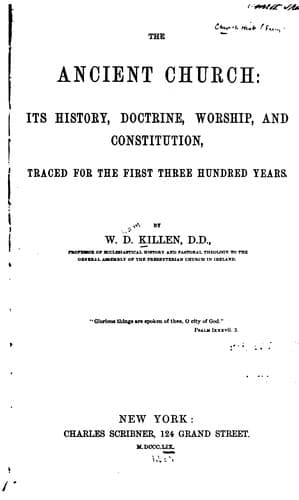
The Ancient Church: Its History, Doctrine, Worship, and ConstitutionKillen, W. D. (William Dool)
Religion
The Ancient Church: Its History, Doctrine, Worship, and Constitution
Killen, W. D. (William Dool)
Church history -- Primitive and early church, ca. 30-600
The story of Ignatius exhibits many marks of error and exaggeration; and
yet it is no easy matter to determine how much of it should be
pronounced fictitious. Few, perhaps, will venture to assert that the
account of his martyrdom is to be rejected as altogether apocryphal; and
still fewer will go so far as to maintain that he is a purely imaginary
character. There is every reason to believe that, very early in the
second century, he was connected with the Church of Antioch; and that,
about the same period, he suffered unto death in the cause of
Christianity. Pliny, who was then Proconsul of Bithynia, mentions that,
as he did not well know, in the beginning of his administration, how to
deal with the accused Christians, he sent those of them who were Roman
citizens to the Emperor, that he might himself pronounce judgment.
[392:1] It is possible that the chief magistrate of Syria pursued the
same course; and that thus Ignatius was transmitted as a prisoner into
Italy. But, upon some such substratum of facts, a mass of incongruous
fictions has been erected. The "Acts of his Martyrdom," still extant,
and written probably upwards of a hundred years after his demise, cannot
stand the test of chronological investigation; and have evidently been
compiled by some very superstitious and credulous author. According to
these Acts, Ignatius was condemned by Trajan at Antioch in the _ninth_
[392:2] year of his reign; but it has been contended that, not until
long afterwards, was the Emperor in the Syrian capital. [392:3] In the
"Acts," Ignatius is described as presenting himself before his sovereign
_of his own accord_, to proclaim his Christianity--a piece of
foolhardiness for which it is difficult to discover any reasonable
apology. The report of the interview between Ignatius and Trajan, as
given in this document, would, if believed, abundantly warrant the
conclusion that the martyr must have entirely lost the humility for
which he is said to have obtained credit when a child; as his conduct,
in the presence of the Emperor, betrays no small amount of boastfulness
and presumption. The account of his transmission to Rome, that he might
be thrown to wild beasts, presents difficulties with which even the most
zealous defenders of his legendary history have found it impossible to
grapple. He was sent away, say they, to the Italian metropolis that the
sight of so distinguished a victim passing through so many cities on his
way to a cruel death might strike terror into the hearts of the
Christian inhabitants. But we are told that he was conveyed from Syria
to Smyrna _by water_, [393:1] so that the explanation is quite
unsatisfactory; and, had the journey been accomplished by land, it would
still be insufficient, as the disciples of that age were unhappily only
too familiar with spectacles of Christian martyrdom. Our perplexity
increases as we proceed more minutely to investigate the circumstances
under which the epistles are reported to have been composed.
Public-domain text, read in full here on John Shaqi.
Reviews
Reviews
No reviews yet
Be the first to share your thoughts on this work.
Elsewhere in the archive
Join the Discussion
Join the discussion
Sign in to leave a comment or review.
Sign InorCreate an account