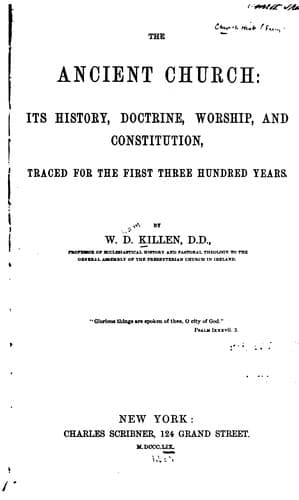
The Ancient Church: Its History, Doctrine, Worship, and ConstitutionKillen, W. D. (William Dool)
Religion
The Ancient Church: Its History, Doctrine, Worship, and Constitution
Killen, W. D. (William Dool)
Church history -- Primitive and early church, ca. 30-600
In the year 1845 a new turn was given to this controversy by the
publication of a Syriac version of three of the Ignatian letters. They
were printed from a manuscript deposited in 1843 in the British Museum,
and obtained, shortly before, from a monastery in the desert of Nitria
in Egypt. The work was dedicated by permission to the Archbishop of
Canterbury, and the views propounded in it were understood to have the
sanction of the English metropolitan. [395:2] Dr Cureton, the editor,
has since entered more fully into the discussion of the subject in his
"Corpus Ignatianum" [395:3]--a volume dedicated to His Royal Highness
the Prince Albert, in which the various texts of all the epistles are
exhibited, and in which the claims of the three recently discovered
letters, as the only genuine productions of Ignatius, are ingeniously
maintained. In the Syriac copies, [396:1] these letters are styled "_The
Three_ Epistles of Ignatius, Bishop, and Martyr," and thus the inference
is suggested that, at one time, they were _the only three_ epistles in
existence. Dr Cureton's statements have obviously made a great
impression upon the mind of the literary public, and there seems at
present to be a pretty general disposition in certain quarters [396:2]
to discard all the other epistles as forgeries, and to accept those
preserved in the Syriac version as the veritable compositions of the
pastor of Antioch.
It must be obvious from the foregoing explanations that increasing light
has wonderfully diminished the amount of literature which once obtained
credit under the name of the venerable Ignatius. In the sixteenth
century he was reputed by many as the author of fifteen letters: it was
subsequently discovered that eight of them must be set aside as
apocryphal: farther investigation convinced critics that considerable
portions of the remaining seven must be rejected: and when the short
text of these epistles was published, [396:3] about the middle of the
seventeenth century, candid scholars confessed that it still betrayed
unequivocal indications of corruption. [396:4] But even some Protestant
writers of the highest rank stoutly upheld their claims, and the learned
Pearson devoted years to the preparation of a defence of their
authority. [397:1] His "Vindiciae Ignatianae" has long been considered
by a certain party as unanswerable; and, though the publication has been
read by very few, [397:2] the advocates of what are called "High-Church
principles" have been reposing for nearly two centuries under the shadow
of its reputation. The critical labours of Dr Cureton have somewhat
disturbed their dream of security, as that distinguished scholar has
adduced very good evidence to shew that about three-fourths of the
matter [397:3] which the Bishop of Chester spent a considerable portion
of his mature age in attempting to prove genuine, is the work of an
impostor. It is now admitted by the highest authorities that _four_ of
Public-domain text, read in full here on John Shaqi.
Reviews
Reviews
No reviews yet
Be the first to share your thoughts on this work.
Elsewhere in the archive
Join the Discussion
Join the discussion
Sign in to leave a comment or review.
Sign InorCreate an account