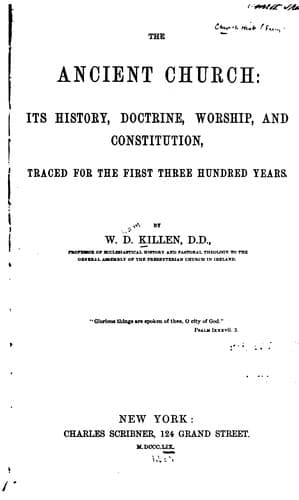
The Ancient Church: Its History, Doctrine, Worship, and ConstitutionKillen, W. D. (William Dool)
Religion
The Ancient Church: Its History, Doctrine, Worship, and Constitution
Killen, W. D. (William Dool)
Church history -- Primitive and early church, ca. 30-600
Whilst
Ignatius is said to have been hurried with great violence and barbarity
from the East to the West, he is at the same time represented, with
strange inconsistency, as remaining for many days together in the same
place, [393:2] as receiving visitors from the churches all around, and
as writing magniloquent epistles. What is still more remarkable, though
he was pressed by the soldiers to hasten forward, and though a
prosperous gale speedily carried his vessel into Italy, [394:1] one of
these letters is supposed to outstrip the rapidity of his own progress,
and to reach Rome before himself and his impatient escort!
Early in the fourth century at least seven epistles attributed to
Ignatius were in circulation, for Eusebius of Caesarea, who then
flourished, distinctly mentions so many, and states to whom they were
addressed. From Smyrna the martyr is said to have written four
letters--one to the Ephesians, another to the Magnesians, a third to the
Trallians, and a fourth to the Romans. From Troas he is reported to have
written three additional letters--one to Polycarp, a second to the
Smyrnaeans, and a third to the Philadelphians. [394:2] At a subsequent
period eight more epistles made their appearance, including two to the
Apostle John, one to the Virgin Mary, one to Maria Cassobolita, one to
the Tarsians, one to the Philippians, one to the Antiochians, and one to
Hero the deacon. Thus, no less than fifteen epistles claim Ignatius of
Antioch as their author.
It is unnecessary to discuss the merits of the eight letters unknown to
Eusebius. They were probably all fabricated after the time of that
historian; and critics have long since concurred in rejecting them as
spurious. Until recently, those engaged in the Ignatian controversy were
occupied chiefly with the examination of the claims of the documents
mentioned by the bishop of Caesarea. Here, however, the strange
variations in the copies tended greatly to complicate the discussion.
The letters of different manuscripts, when compared together, disclosed
extraordinary discrepancies; for, whilst all the codices contained much
of the same matter, a letter in one edition was, in some cases, about
double the length of the corresponding letter in another. Some writers
contended for the genuineness of the shorter epistles, and represented
the larger as made up of the true text extended by interpolations;
whilst others pronounced the larger letters the originals, and condemned
the shorter as unsatisfactory abridgments. [395:1] But, though both
editions found most erudite and zealous advocates, many critics of
eminent ability continued to look with distrust upon the text, as well
of the shorter, as of the larger letters; whilst not a few were disposed
to suspect that Ignatius had no share whatever in the composition of any
of these documents.
Public-domain text, read in full here on John Shaqi.
Reviews
Reviews
No reviews yet
Be the first to share your thoughts on this work.
Elsewhere in the archive
Join the Discussion
Join the discussion
Sign in to leave a comment or review.
Sign InorCreate an account