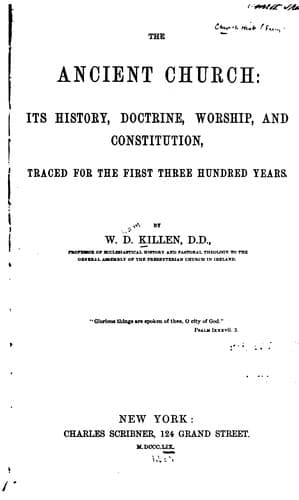
The Ancient Church: Its History, Doctrine, Worship, and ConstitutionKillen, W. D. (William Dool)
Religion
The Ancient Church: Its History, Doctrine, Worship, and Constitution
Killen, W. D. (William Dool)
Church history -- Primitive and early church, ca. 30-600
As it can be thus shewn that the letter of Polycarp, when tested by
impartial criticism, refuses to accredit the Epistles ascribed to
Ignatius of Antioch, it follows that, with the single exception of
Origen, no father of the first three centuries has noticed this
correspondence. Had these letters, at the alleged date of their
appearance, attracted such attention as they would themselves lead us to
believe, is it possible that no writer for upwards of a century after
the demise of their reputed author, would have bestowed upon them even a
passing recognition? They convey the impression that, when Ignatius was
on his way to Rome, all Asia Minor was moved at his presence--that
Greece caught the infection of excitement--and that the Western capital
itself awaited, with something like breathless anxiety, the arrival of
the illustrious martyr. Strange, indeed, then that even his letter to
the Romans is mentioned by no Western father until between two and three
hundred years after the time of its assumed publication! Nor were
Western writers wanting who would have sympathised with its spirit. It
would have been quite to the taste of Tertullian, and he could have
quoted it to shew that some of the peculiar principles of Montanism had
been held by a man of the apostolic era. Nor can it be said that had the
letter then been in existence, it was likely to have escaped his
observation. He had lived for years in Rome, and we have good reason to
believe that he was a presbyter of the Church of the Imperial city. A
man of his inquiring spirit, and literary habits, must have been well
acquainted with the Epistle had it obtained currency in Italy. But in
not one of his numerous treatises does he ever speak of it, or even name
its alleged author. [409:1] Hippolytus of Portus is another writer who
might have been expected to know something of this production. He lived
within a few miles of Rome, and he was conversant with the history of
its Church and with its ecclesiastical memorials. He, as well as
Tertullian, could have sympathised with the rugged and ascetic spirit
pervading the Ignatian correspondence. But, even in his treatise against
all heresies, he has not fortified his arguments by any testimony from
these letters. He had evidently never heard, of the now far famed
documents. [409:2]
Public-domain text, read in full here on John Shaqi.
Reviews
Reviews
No reviews yet
Be the first to share your thoughts on this work.
Elsewhere in the archive
Join the Discussion
Join the discussion
Sign in to leave a comment or review.
Sign InorCreate an account