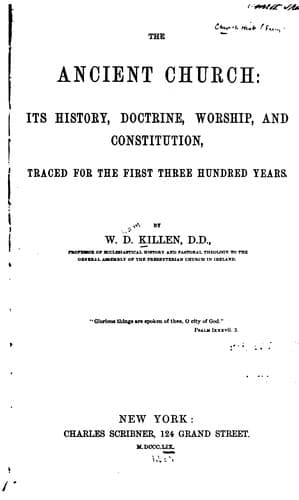
The Ancient Church: Its History, Doctrine, Worship, and ConstitutionKillen, W. D. (William Dool)
Religion
The Ancient Church: Its History, Doctrine, Worship, and Constitution
Killen, W. D. (William Dool)
Church history -- Primitive and early church, ca. 30-600
The conclusion to be drawn from these facts must be sufficiently
obvious. The Ignatian Epistles began to be fabricated in the time of
Origen; and the first edition of them appeared, not at Troas or Smyrna,
but in Syria or Palestine. At an early period festivals were kept in
honour of the martyrs; and on his natal day, [409:3] why should not the
Church of Antioch have something to tell of her great Ignatius? The Acts
of his Martyrdom were probably written in the former part of the third
century--a time when the work of ecclesiastical forgery was rife
[409:4]--and the Epistle to the Romans, which is inserted in these Acts,
is in all likelihood of earlier date than any of the other letters. The
Epistle to the Ephesians, perhaps, next made its appearance, and then
followed the Epistle to Polycarp. These letters gradually crept into
circulation as "The Three Epistles of Ignatius, Bishop, and Martyr."
There is every reason to believe that, as edited by Dr Cureton, they are
now presented to the public in their original _language_, as well as in
their original form. Copies of these short letters are not known to be
extant in any manuscript either Greek or Latin. Dr Cureton has not
attempted any explanation of this emphatic fact. If the Epistle to the
Romans, in its newly discovered form, is genuine, how does it happen
that there are no previous traces of its existence in the Western
Church? How are we to account for the extraordinary circumstance that
the Church of Rome can produce no copy of it in either Greek or Latin?
She had every reason to preserve such a document had it ever come into
her possession; for, even considered as a pious fraud of the third
century, the address "_to her who sitteth at the head_ in the place of
the country of the Romans," [410:1] is one of the most ancient
testimonies to her early pre-eminence to be found in the whole range of
ecclesiastical literature. Why should she have permitted it to be
supplanted by an interpolated document? Can any man, who adopts the
views of Dr Cureton, fairly answer such an inquiry?
It is plain that the mistake or corruption of a word in the postscript
of the Epistle of Polycarp has had much to do with this Ignatian
imposture. In some worn or badly written manuscript, Syria was perhaps
read instead of Smyrna, and the false reading probably led to the
incubation of the whole brood of Ignatian letters. The error, whether of
accident or design, was adopted by Eusebius, [411:1] and from him passed
into general currency. We may thus best account for the strange
multiplication of these Ignatian epistles. It was clear that the
Ignatius spoken of by Polycarp had written more letters than what first
appeared, [411:2] and thus the epistles to the Smyrnaeans, the
Magnesians, the Trallians, and the Philadelphians, in due time emerged
into notice. At a subsequent date the letters to the Philippians, the
Antiochians, the Virgin Mary, and others, were forthcoming.
Public-domain text, read in full here on John Shaqi.
Reviews
Reviews
No reviews yet
Be the first to share your thoughts on this work.
Elsewhere in the archive
Join the Discussion
Join the discussion
Sign in to leave a comment or review.
Sign InorCreate an account