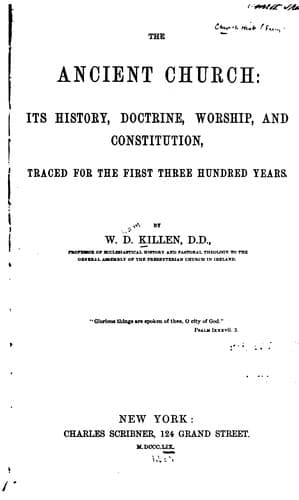
The Ancient Church: Its History, Doctrine, Worship, and ConstitutionKillen, W. D. (William Dool)
Religion
The Ancient Church: Its History, Doctrine, Worship, and Constitution
Killen, W. D. (William Dool)
Church history -- Primitive and early church, ca. 30-600
On the fall of
Jerusalem, the Church of Antioch was herself the first Christian
community in the Empire. She had a higher antiquity, a more
distinguished prestige, and perhaps a more numerous membership than any
other Church in existence. In the Syrian metropolis the disciples had
first been called Christians; there, Barnabas and Paul had been
separated to the work to which the Lord had called them; there, Peter
had preached; and there, prophets had laboured. But a century had
brought about a wonderful change. The Church of Rome had meanwhile
obtained the first place among Christian societies; and, before the
middle of the third century, "the See of Peter" was honoured as the
centre of catholic unity. Towards the close of the second century, many
persons of rank and power joined her communion, [419:1] and her
political influence was soon felt to be so formidable that even the
Roman Emperor began to be jealous of the Roman bishop. [419:2] But the
Ignatian forger did not take into account this ecclesiastical
revolution. Hence he here incautiously speaks in the language of his own
age, and writing "to her _who sitteth at the head_ in the place of the
country of the Romans," he says to her with all due humility--"I am not
commanding you like Peter and Paul" [419:3]--"Ye have taught
others"--"It is easy for you to do whatsoever you please."
IV. Various words in these Epistles have a meaning which they did not
acquire until long after the time of Ignatius. Thus, the term employed
in the days of the Apostles to denote _purity_, or _chastity_, here
signifies _celibacy_. [419:4] Even in the commencement of the third
century those who led a single life were beginning to be considered
Christians of a superior type, as contrasted with those who were
married; and clerical celibacy was becoming very fashionable. [420:1]
The Ignatian fabricator writes under the influence of the popular
sentiment. "The house of the Church" at Antioch, of which Paul of
Samosata kept possession after his deposition about A.D. 269, [420:2]
seems to have been a dwelling appropriated to the use of the
ecclesiastical functionaries, [420:3] and the schemer who wrote the
first draft of these letters evidently believed that the ministers of
Christ should be a brotherhood of bachelors. Hence Ignatius is made thus
to address Polycarp and his clergy--"Labour together one with another;
make the struggle together one with another; run together one with
another; suffer together one with another; _sleep together one with
another; rise together one with another_." Polycarp and others of the
elders of Smyrna were probably married; [420:4] so that some
inconvenience might have attended this arrangement.
Public-domain text, read in full here on John Shaqi.
Reviews
Reviews
No reviews yet
Be the first to share your thoughts on this work.
Elsewhere in the archive
Join the Discussion
Join the discussion
Sign in to leave a comment or review.
Sign InorCreate an account