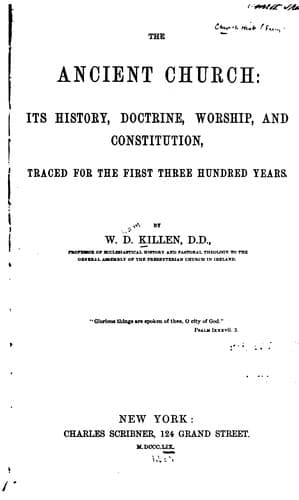
The Ancient Church: Its History, Doctrine, Worship, and ConstitutionKillen, W. D. (William Dool)
Religion
The Ancient Church: Its History, Doctrine, Worship, and Constitution
Killen, W. D. (William Dool)
Church history -- Primitive and early church, ca. 30-600
The word _bishop_ is another term found in these Epistles, and employed
in a sense which it did not possess at the alleged date of their
publication. Every one knows that, in the New Testament, it does not
signify the chief pastor of a Church; but, about the middle of the
second century, as will subsequently appear, [421:1] it began to have
this acceptation. Clement of Rome, writing a few years before the time
of the martyrdom of Ignatius, uses the words bishop and presbyter
interchangeably. [421:2] Polycarp, in his own Epistle, dictated,
perhaps, forty years after the death of the Syrian pastor, still adheres
to the same phraseology. In the Peshito version of the New Testament,
executed probably in the former half of the second century, [421:3] the
same terminology prevails. [421:4] Ignatius, however, is far in advance
of his generation. When new terms are introduced, or when new meanings
are attached to designations already current, it seldom happens that an
old man changes his style of speaking. He is apt to persevere, in spite
of fashion, in the use of the phraseology to which he has been
accustomed from his childhood. But Ignatius is an exception to all such
experience, for he repeats the new nomenclature with as much flippancy
as if he had never heard any other. [421:5] Surely this minister of
Antioch must be worthy of all the celebrity he has attained, for he can
not only carry on a written correspondence with the dead, but also
anticipate by half a century even the progress of language!
V. The puerilities, vapouring, and mysticism of these letters proclaim
their forgery. We would expect an aged apostolic minister, on his way to
martyrdom, to speak as a man in earnest, to express himself with some
degree of dignity, and to eschew trivial and ridiculous comparisons.
But, when treating of a grave subject, what can be more silly or
indecorous than such language as the following--"Ye are raised on high
by the engine of Jesus Christ, which is the cross, and ye are drawn by
the rope, which is the Holy Ghost, and your pulley is your faith."
[422:1] Well may the Christian reader exclaim, with indignation, as he
peruses these words, Is the Holy Ghost then a mere rope? Is that
glorious Being who worketh in us to will and to do according to His own
good pleasure, a mere piece of tackling pertaining to the ecclesiastical
machinery, to be moved and managed according to the dictation of Bishop
Ignatius? [422:2] But the frivolity of this impostor is equalled by his
gasconade. He thus tantalises the Romans with an account of his
attainments--"I am able to write to you heavenly things, _but I fear
lest I should do you an injury_." .....
Public-domain text, read in full here on John Shaqi.
Reviews
Reviews
No reviews yet
Be the first to share your thoughts on this work.
Elsewhere in the archive
Join the Discussion
Join the discussion
Sign in to leave a comment or review.
Sign InorCreate an account