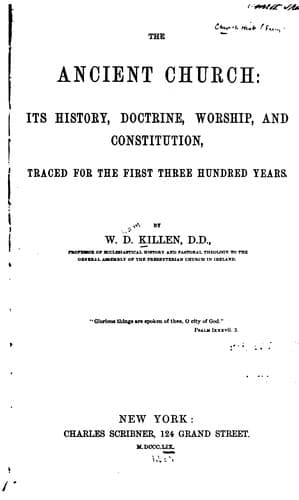
The Ancient Church: Its History, Doctrine, Worship, and ConstitutionKillen, W. D. (William Dool)
Religion
The Ancient Church: Its History, Doctrine, Worship, and Constitution
Killen, W. D. (William Dool)
Church history -- Primitive and early church, ca. 30-600
"I am able to know heavenly things, and the places of angels, and the
station of powers that are visible and invisible." Where did he gather
all this recondite lore? Certainly not from the Old or New Testament.
May we not safely pronounce this man to be one who seeks to be wise
above what is written, "intruding into those things which he hath not
seen, vainly puffed up by his fleshly mind?" [422:3] He seems, indeed,
to have himself had some suspicion that such was his character, for he
says, again, to his brethren of the Western metropolis--"I know many
things in God, but I moderate myself that I may not _perish through
boasting_; for now it is becoming to me that I should fear the more
abundantly, and should not look to _those that puff me up_." Let us now
hear a specimen of the mysticism of this dotard. "There was hidden from
the Ruler of this world the virginity of Mary, and the birth of our
Lord, and the three mysteries of the shout, which were done in the
quietness of God by means of the star, and here by the manifestation of
the Son magic began to be dissolved." [423:1] Who can undertake to
expound such jargon? What are we to understand by "the quietness of
God?" Who can tell how "the three mysteries of the shout" were "done by
means of the star?"
VI. The unhallowed and insane anxiety for martyrdom which appears
throughout these letters is another decisive proof of their fabrication.
He who was, in the highest sense, the Faithful Witness betrayed no
fanatic impatience for the horrid tragedy of crucifixion; and, true to
the promptings of his human nature, he prayed, in the very crisis of His
agony--"O my Father, _if it be possible, let this cup pass from me_."
[423:2] The Scriptures represent the most exalted saints as shrinking
instinctively from suffering. In the prophecy announcing the violent
death of Peter, it is intimated that even the intrepid apostle of the
circumcision would feel disposed to recoil from the bloody ordeal. "When
thou shalt be old," said our Lord to him, "thou shalt stretch forth thy
hands, and another shall gird thee, and carry thee _whither thou
wouldest not_." [423:3] Paul mentions with thankfulness how, on a
critical occasion, the Lord stood with him, and "_delivered_" him "out
of the mouth of the lion." [423:4] Long after the apostolic age, the
same spirit continued to be cherished, and hence we are told of Polycarp
that, even when bowed down by the weight of years, he felt it right to
retire out of the way of those who sought his destruction. The
disciples, whom he had so long taught, took the same view of Christian
duty; and accordingly, in the Epistle of the Church of Smyrna, which
records his martyrdom, the conduct of those who "present themselves _of
their own accord_ to the trial" is emphatically condemned. [424:1] "We
do not," say the believers of Smyrna, "commend those who offer
themselves to persecution, _seeing the gospel teaches no such thing_."
Public-domain text, read in full here on John Shaqi.
Reviews
Reviews
No reviews yet
Be the first to share your thoughts on this work.
Elsewhere in the archive
Join the Discussion
Join the discussion
Sign in to leave a comment or review.
Sign InorCreate an account