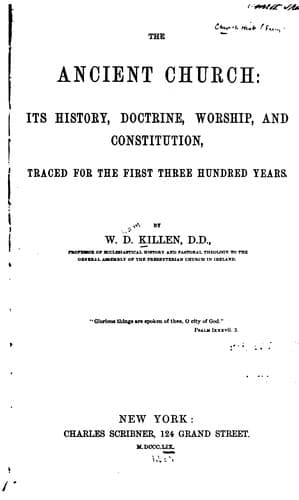
The Ancient Church: Its History, Doctrine, Worship, and ConstitutionKillen, W. D. (William Dool)
Religion
The Ancient Church: Its History, Doctrine, Worship, and Constitution
Killen, W. D. (William Dool)
Church history -- Primitive and early church, ca. 30-600
When reviewing the external evidence in support of these Epistles, we
have had occasion to shew that they were probably fabricated in the
former part of the third century. The internal evidence corroborates the
same conclusion. Ecclesiastical history attests that during the fifty
years preceding the death of Cyprian, [425:3] the principles here put
forward were fast gaining the ascendency. As early as the days of
Tertullian, ritualism was rapidly supplanting the freedom of evangelical
worship; baptism was beginning to be viewed as an "armour" of marvellous
potency; [425:4] the tradition that the great Church of the West had
been founded by Peter and Paul was now extensively propagated; and there
was an increasing disposition throughout the Empire to recognise the
precedence of "her who sitteth at the head in the place of the country
of the Romans." It is apparent from the writings of Cyprian that in some
quarters the "church system" was already matured. The language ascribed
to Ignatius--"Be careful for unanimity, than _which there is nothing
more_ excellent" [426:1]--then expressed a prevailing sentiment. To
maintain unity was considered a higher duty than to uphold truth, and to
be subject to the bishop was deemed one of the greatest of evangelical
virtues. Celibacy was then confounded with chastity, and mysticism was
extensively occupying the place of scriptural knowledge and intelligent
conviction. And the admiration of martyrdom which presents itself in
such a startling form in these Epistles was one of the characteristics
of the period. Paul taught that a man may give his body to be burned and
yet want the spirit of the gospel; [426:2] but Origen does not scruple
to describe martyrdom as "the cup of salvation," the baptism which
cleanses the sufferer, the act which makes his blood precious in God's
sight to the redemption of others. [426:3] Do not all these
circumstances combined supply abundant proof that these Epistles were
written in the time of this Alexandrian father? [426:4]
It is truly wonderful that men, such as Dr Cureton, have permitted
themselves to be befooled by these Syriac manuscripts. It is still more
extraordinary that writers, such as the pious and amiable Milner,
[426:5] have published, with all gravity, the rhapsodies of Ignatius for
the edification of their readers. It would almost appear as if the name
_Bishop_ has such a magic influence on some honest and enlightened
Episcopalians, that when the interests of their denomination are
supposed to be concerned, they can be induced to close their eyes
against the plainest dictates of common sense and the clearest light of
historical demonstration. In deciding upon matters of fact the spirit of
party should never be permitted to interfere. Truth is the common
property of the catholic Church; and no good and holy cause can require
the support of an apocryphal correspondence.
Public-domain text, read in full here on John Shaqi.
Reviews
Reviews
No reviews yet
Be the first to share your thoughts on this work.
Elsewhere in the archive
Join the Discussion
Join the discussion
Sign in to leave a comment or review.
Sign InorCreate an account