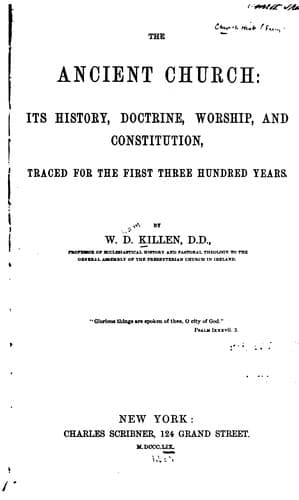
The Ancient Church: Its History, Doctrine, Worship, and ConstitutionKillen, W. D. (William Dool)
Religion
The Ancient Church: Its History, Doctrine, Worship, and Constitution
Killen, W. D. (William Dool)
Church history -- Primitive and early church, ca. 30-600
It is no mean proof of the sagacity of the great Calvin, that, upwards
of three hundred years ago, he passed a sweeping sentence of
condemnation on these Ignatian Epistles. At the time, many were startled
by the boldness of his language, and it was thought that he was somewhat
precipitate in pronouncing such a decisive judgment. But he saw
distinctly, and he therefore spoke fearlessly. There is a far more
intimate connexion than many are disposed to believe between sound
theology and sound criticism, for a right knowledge of the Word of God
strengthens the intellectual vision, and assists in the detection of
error wherever it may reveal itself. Had Pearson enjoyed the same clear
views of gospel truth as the Reformer of Geneva, he would not have
wasted so many precious years in writing a learned vindication of the
nonsense attributed to Ignatius. Calvin knew that an apostolic man must
have been acquainted with apostolic doctrine, and he saw that these
letters must have been the productions of an age when the pure light of
Christianity was greatly obscured. Hence he denounced them so
emphatically: and time has verified his deliverance. His language
respecting them has been often quoted, but we feel we cannot more
appropriately close our observations on this subject than by another
repetition of it. "There is nothing more abominable than that trash
which is in circulation under the name of Ignatius." [428:1]
CHAPTER IV.
THE GNOSTICS, THE MONTANISTS, AND THE MANICHAEANS.
When Christianity made its appearance in the world, it produced a
profound sensation. It spread on all sides with great rapidity; it was
at once felt to be a religion for the common people; and some
individuals of highly cultivated minds soon acknowledged its authority.
For a time its progress was impeded by the persecutions of Nero and
Domitian; but, about the beginning of the second century, it started
upon a new career of prosperous advancement, and quickly acquired such a
position that the most distinguished scholars and philosophers could no
longer overlook its pretensions. In the reigns of Trajan and Hadrian, a
considerable number of men of learning were already in its ranks; but it
would appear that, on the whole, it derived very equivocal aid from the
presence of these new adherents. Not a few of the literati who joined
its standard attempted to corrupt it; and one hundred and twenty years
after the death of the Apostle John, the champions of orthodoxy had to
contend against no less than thirty-two heresies. [429:1]
Public-domain text, read in full here on John Shaqi.
Reviews
Reviews
No reviews yet
Be the first to share your thoughts on this work.
Elsewhere in the archive
Join the Discussion
Join the discussion
Sign in to leave a comment or review.
Sign InorCreate an account