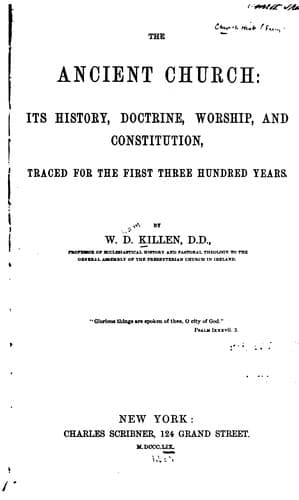
The Ancient Church: Its History, Doctrine, Worship, and ConstitutionKillen, W. D. (William Dool)
Religion
The Ancient Church: Its History, Doctrine, Worship, and Constitution
Killen, W. D. (William Dool)
Church history -- Primitive and early church, ca. 30-600
Of those who now adulterated the gospel, the Gnostics were by far the
most subtle, the most active, and the most formidable. The leaders of
the party were all men of education; and as they were to be found
chiefly in the large cities, the Church in these centres of influence
was in no small degree embarrassed and endangered by their speculations.
Some of the peculiarities of Gnosticism have been already noticed;
[430:1] but as the second century was the period when it made most
progress and awakened most anxiety, we must here advert more distinctly
to its outlines. The three great antagonists of the gospel were the
Grecian philosophy, the heathen mythology, and a degenerate Judaism; and
Gnosticism may be described as an attempt to effect a compromise between
Christianity and these rivals. As might have been expected, the attempt
met with much encouragement; for many, who hesitated to accept the new
religion unconditionally, were constrained to acknowledge that it
exhibited many indications of truth and divinity; and they were,
therefore, prepared to look on it with favour when presented to them in
an altered shape and furnished with certain favourite appendages. The
Gnostics called themselves believers; and their most celebrated teachers
would willingly have remained in the bosom of the Church; but it soon
appeared that their principles were subversive of the New Testament
revelation; and they were accordingly excluded from ecclesiastical
fellowship.
Gnosticism assumed a variety of forms, and almost every one of its
teachers had his own distinctive creed; but, as a system, it was always
known by certain remarkable features. It uniformly ignored the doctrine
that God made all things out of nothing; [430:2] and, taking for granted
the eternity of matter, it tried to account, on philosophical
principles, for the moral and spiritual phenomena of the world which we
inhabit. The _Gnosis_, [430:3] or knowledge, which it supplied, and from
which it derived its designation, was a strange congeries of wild
speculations. The Scriptures describe the Most High as humbling Himself
to behold the things that are on earth, [431:1] as exercising a constant
providence over all His creatures, as decking the lilies of the valley,
and as numbering the very hairs of our heads; but Gnosticism exhibited
the Supreme God as separated by an immeasurable interval from matter,
and as having no direct communication with anything thus contaminated.
The theory by means of which many of its adherents endeavoured to solve
the problem of the origin of evil, [431:2] and to trace the connexion
between the finite and the infinite, was not without ingenuity. They
maintained that a series of Aeons, or divine beings, emanated from the
Primal Essence; but, as sound issuing from a given point gradually
becomes fainter until it is finally lost in silence, each generation of
Aeons, as it receded from the great Fountain of Spiritual Existence,
Public-domain text, read in full here on John Shaqi.
Reviews
Reviews
No reviews yet
Be the first to share your thoughts on this work.
Elsewhere in the archive
Join the Discussion
Join the discussion
Sign in to leave a comment or review.
Sign InorCreate an account