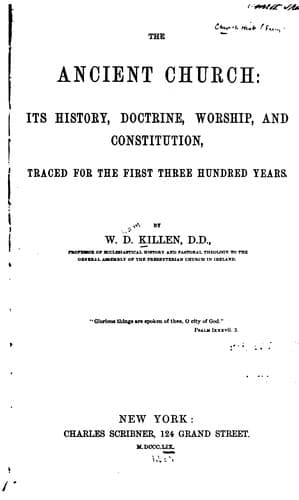
The Ancient Church: Its History, Doctrine, Worship, and Constitution — John Shaqi
The Ancient Church: Its History, Doctrine, Worship, and ConstitutionKillen, W. D. (William Dool)
Religion
The Ancient Church: Its History, Doctrine, Worship, and Constitution
Killen, W. D. (William Dool)
Church history -- Primitive and early church, ca. 30-600
The miracles of Christ illustrated, as well as confirmed, His doctrines.
When, for instance, He converted the water into wine at the marriage in
Cana of Galilee. [24:6] He taught, not only that he approved of wedlock,
but also that, within proper limits, He was disposed to patronise the
exercise of a generous hospitality, in some cases He required faith in
the individuals whom He vouchsafed to cure, [24:7] thus distinctly
suggesting the way of a sinner's salvation. Many of His miracles were
obviously of a typical character. When He acted as the physician of the
body, He indirectly gave evidence of His efficiency as the physician of
the soul; when He restored sight to the blind, He indicated that He
could turn men from darkness to light; when He raised the dead, He
virtually demonstrated His ability to quicken such as are dead in
trespasses and sins. Those who witnessed the visible exhibitions of His
power were prepared to listen with the deepest interest to His words
when He declared--"I am the light of the world; he that followeth me
shall not walk in darkness, but shall have the _light of life_." [25:1]
Though our Lord's conduct, as a public teacher, fully sustained His
claims as the Messiah, it must have been a complete enigma to all
classes of politicians. He did not seek to obtain power by courting the
favour of the great, neither did He attempt to gain popularity by
flattering the prejudices of the multitude. He wounded the national
pride by hinting at the destruction of the temple; He gave much offence
by holding intercourse with the odious publicans; and with many, He
forfeited all credit, as a patriot, by refusing to affirm the
unlawfulness of paying tribute to the Roman emperor. The greatest human
characters have been occasionally swayed by personal predilections or
antipathies, but, in the life of Christ, we can discover no memorial of
any such infirmity. Like a sage among children, He did not permit
Himself to be influenced by the petty partialities, whims, or
superstitions of His countrymen. He inculcated a theological system for
which He could not expect the support of any of the existing classes of
religionists. He differed from the Essenes, as He did not adopt their
ascetic habits; He displeased the Sadducees, by asserting the doctrine
of the resurrection; He provoked the Pharisees, by declaring that they
worshipped God in vain, teaching for doctrines the commandments of men;
and He incurred the hostility of the whole tribe of Jewish zealots, by
maintaining His right to supersede the arrangements of the Mosaic
economy. By pursuing this independent course He vindicated His title to
the character of a Divine lawgiver, but at the same time He forfeited a
vast amount of sympathy and aid upon which He might otherwise have
calculated.
Public-domain text, read in full here on John Shaqi.
Reviews
Reviews
No reviews yet
Be the first to share your thoughts on this work.
Join the Discussion
Join the discussion
Sign in to leave a comment or review.
Sign InorCreate an account