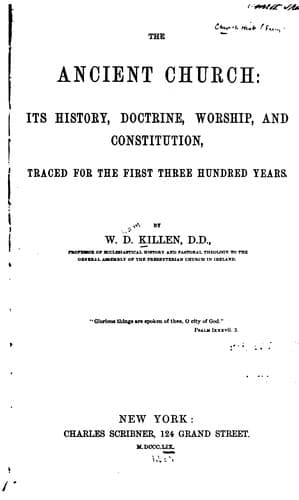
The Ancient Church: Its History, Doctrine, Worship, and ConstitutionKillen, W. D. (William Dool)
Religion
The Ancient Church: Its History, Doctrine, Worship, and Constitution
Killen, W. D. (William Dool)
Church history -- Primitive and early church, ca. 30-600
The death of Christ, of which all the evangelists treat so particularly,
is the most awful and the most momentous event in the history of the
world. He, no doubt, fell a victim to the malice of the rulers of the
Jews; but He was delivered into their hands "by the determinate counsel
and foreknowledge of God;" [28:1] and if we discard the idea that He was
offered up as a vicarious sacrifice, we must find it impossible to give
anything like a satisfactory account of what occurred in Gethsemane and
at Calvary. The amount of physical suffering He sustained from man did
not exceed that endured by either of the malefactors with whom He was
associated; and such was His magnanimity and fortitude, that, had He
been an ordinary martyr, the prospect of crucifixion would not have been
sufficient to make Him "exceeding sorrowful" and "sore amazed." [28:2]
His holy soul must have been wrung with no common agony, when "His sweat
was as it were great drops of blood falling down to the ground," [28:3]
and when He was forced to cry out--"My God, my God, why hast thou
forsaken me?" [28:4] In that hour of "the power of darkness" He was
"smitten of God and afflicted," and there was never sorrow like unto His
sorrow, for upon Him were laid "the iniquities of us all."
The incidents which accompanied the death of Jesus were even more
impressive than those which signalised His birth. When He was in the
garden of Gethsemane there appeared unto Him an angel from Heaven
strengthening Him. [28:5] During the three concluding hours of His
intense anguish on the cross, there was darkness overall the land,
[28:6] as if nature mourned along with the illustrious sufferer. When He
bowed His head on Calvary and gave up the ghost, the event was marked by
notifications such as never announced the demise of any of this world's
great potentates, for "the veil of the temple was rent in twain," and
the rocks were cleft asunder, and the graves were opened, and the earth
trembled. [29:1] "The centurion and they that were with him," in
attendance at the execution, seem to have been Gentiles; and though,
doubtless, they had heard that Jesus claimed to be the Messiah of the
Jews, they perhaps very imperfectly comprehended the import of the
designation; but they were forthwith overwhelmed with the conviction,
that He, whose death they had just witnessed, must have given a true
account of His mission and His dignity, for "when they saw the
earthquake, and those things that were done, they feared greatly,
saying--Truly this was _the Son of God_" [29:2]
Public-domain text, read in full here on John Shaqi.
Reviews
Reviews
No reviews yet
Be the first to share your thoughts on this work.
Join the Discussion
Join the discussion
Sign in to leave a comment or review.
Sign InorCreate an account