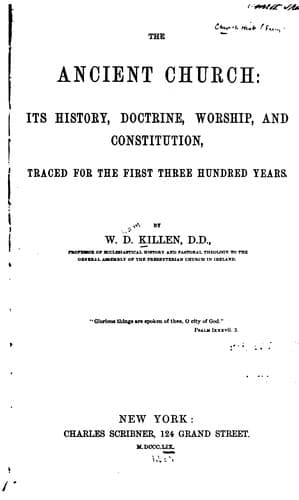
The Ancient Church: Its History, Doctrine, Worship, and ConstitutionKillen, W. D. (William Dool)
Religion
The Ancient Church: Its History, Doctrine, Worship, and Constitution
Killen, W. D. (William Dool)
Church history -- Primitive and early church, ca. 30-600
original significance; and hence, when an apostle died, the survivors no
longer deemed it necessary to take steps for the appointment of a
successor. We find accordingly that when Herod "killed James, the
brother of John, with the sword," [68:1] no other individual was
selected to occupy the vacant apostleship.
It has been already stated that when Paul appeared in Jerusalem for the
first time after his conversion, he received, when praying in the
temple, a divine communication informing him of his mission to the
heathen. [68:2] It would seem that, during his present visit, as the
bearer of the contributions from Antioch, he was favoured with another
revelation. In his Second Epistle to the Corinthians he apparently
refers to this most comfortable, yet mysterious, manifestation. "I
know," [68:3] says he, "a man in Christ fourteen years ago [68:4]
(whether in the body, I cannot tell, or whether out of the body, I
cannot tell; God knoweth) such an one caught up to the third heaven. And
I know such a man (whether in the body, or out of the body, I cannot
tell; God knoweth) that he was caught up into paradise, and heard
unspeakable words which it is not lawful for man to utter." [68:5] The
present position of the apostle explains the design of this sublime and
delightful vision. As Moses was encouraged to undertake the deliverance
of his countrymen when God appeared to him in the burning bush, [68:6]
and as Isaiah was emboldened to go forth, as the messenger of the Lord
of hosts, when he saw Jehovah sitting upon His throne attended by the
seraphim, [68:7] so Paul was stirred up by an equally impressive
revelation to gird himself for the labours of a new appointment. He was
about to commence a more extensive missionary career, and before
entering upon so great and so perilous an undertaking, the King of kings
condescended to encourage him by admitting him to a gracious audience,
and by permitting him to enjoy some glimpses of the glory of those
realms of light where "they that be wise shall shine as the brightness
of the firmament, and they that turn many to righteousness as the stars
for ever and ever."
CHAPTER V.
THE ORDINATION OF PAUL AND BARNABAS; THEIR MISSIONARY TOUR
IN ASIA MINOR; AND THE COUNCIL OF JERUSALEM.
A.D. 44 TO A.D. 51.
Soon after returning from Jerusalem to Antioch, Paul was formally
invested with his new commission. His fellow-deputy, Barnabas, was
appointed, as his coadjutor, in this important service. "Now," says the
evangelist, "there were in the church that was at Antioch certain
prophets and teachers, as Barnabas, and Simeon that was called Niger,
and Lucius of Cyrene, and Manaen, which had been brought up with Herod
the tetrarch, and Saul. As they ministered to the Lord and fasted, the
Holy Ghost said--Separate me Barnabas and Saul for the work whereunto I
have called them. And when they had fasted, and prayed, and laid their
hands on them, they sent them away." [70:1]
Public-domain text, read in full here on John Shaqi.
Reviews
Reviews
No reviews yet
Be the first to share your thoughts on this work.
Elsewhere in the archive
Join the Discussion
Join the discussion
Sign in to leave a comment or review.
Sign InorCreate an account