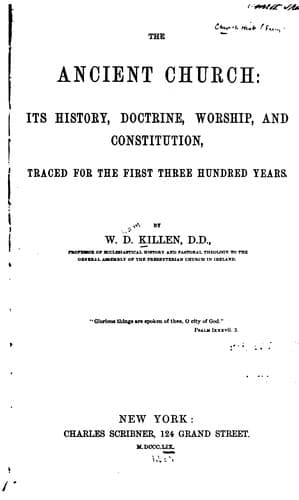
The Ancient Church: Its History, Doctrine, Worship, and ConstitutionKillen, W. D. (William Dool)
Religion
The Ancient Church: Its History, Doctrine, Worship, and Constitution
Killen, W. D. (William Dool)
Church history -- Primitive and early church, ca. 30-600
Ten years had now elapsed since the conversion of Paul; and during the
greater part of this period, he had been busily engaged in the
dissemination of the gospel. In the days of his Judaism the learned
Pharisee had, no doubt, been accustomed to act as a teacher in the
synagogues, and, when he became obedient to the faith, he was permitted,
as a matter of course, to expound his new theology in the Christian
assemblies. Barnabas, his companion, was a Levite; [70:2] and as his
tribe was specially charged with the duty of public instruction, [71:1]
he too had probably been a preacher before his conversion. Both these
men had been called of God to labour as evangelists, and the Head of the
Church had already abundantly honoured their ministrations; but hitherto
neither of them seems to have been clothed with pastoral authority by
any regular ordination. Their constant presence in Antioch was now no
longer necessary, so that they were thus left at liberty to prosecute
their missionary operations in the great field of heathendom; and at
this juncture it was deemed necessary to designate them, in due form, to
their "ministry and apostleship." "The Holy Ghost said--Separate me
Barnabas and Saul for the work whereunto I have called them." When we
consider the present circumstances of these two brethren, we may see,
not only why these instructions were given, but also why their
observance has been so distinctly registered.
It is apparent that Barnabas and Saul were now called to a position of
higher responsibility than that which they had previously occupied. They
had heretofore acted simply as preachers of the Christian doctrine.
Prompted by love to their common Master, and by a sense of individual
obligation, they had endeavoured to diffuse all around them a knowledge
of the Redeemer. They taught in the name of Jesus, just because they
possessed the gifts and the graces required for such a service; and, as
their labours were acknowledged of God, they were encouraged to
persevere. But they were now to go forth as a solemn deputation, under
the sanction of the Church, and not only to proclaim the truth, but also
to baptize converts, to organise Christian congregations, and to ordain
Christian ministers. It was, therefore, proper, that, on this occasion,
they should be regularly invested with the ecclesiastical commission.
Public-domain text, read in full here on John Shaqi.
Reviews
Reviews
No reviews yet
Be the first to share your thoughts on this work.
Elsewhere in the archive
Join the Discussion
Join the discussion
Sign in to leave a comment or review.
Sign InorCreate an account