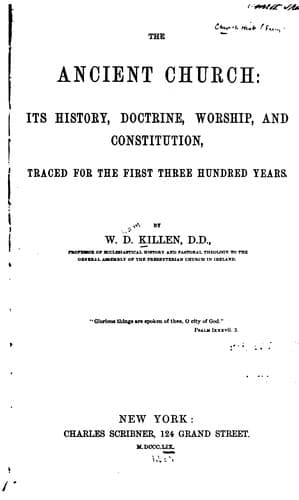
The Ancient Church: Its History, Doctrine, Worship, and ConstitutionKillen, W. D. (William Dool)
Religion
The Ancient Church: Its History, Doctrine, Worship, and Constitution
Killen, W. D. (William Dool)
Church history -- Primitive and early church, ca. 30-600
If the proceedings of the missionaries, before their committal to
prison, produced such a ferment, it is clear that the circumstances
attending their incarceration were not calculated to abate the
excitement. It soon appeared that they had sources of enjoyment which no
human authority could either destroy or disturb; for as they lay in the
pitchy darkness of their dungeon with their feet compressed in the
stocks, their hearts overflowed with divine comfort. "At midnight Paul
and Silas prayed, and sang praises unto God: and the prisoners heard
them." [94:2] What must have been the wonder of the other inmates of the
jail, as these sounds fell upon their ears! Instead of a cry of distress
issuing from "the inner prison," there was the cheerful voice of
thanksgiving! The apostles rejoiced that they were counted worthy to
suffer in the service of Christ. The King of the Church sympathised with
His oppressed saints, and speedily vouchsafed to them most wonderful
tokens of encouragement. Scarcely had they finished their song of praise
when it was answered by a very significant response, proclaiming that
they were supported by a power which could crush the might of Rome.
"Suddenly there was a great earthquake, so that the foundations of the
prison were shaken, and immediately all the doors were opened, and every
one's bands were loosed." [95:1]
It is not improbable that the mind of the jailer had already been ill at
ease. He must have heard of the extraordinary history of the damsel with
the spirit of divination who announced that his prisoners were the
servants of the Most High God, and that they shewed unto men the way of
salvation. Rumour had, perhaps, supplied him with some information in
reference to their doctrines; and during even his short intercourse with
Paul and Silas in the jail, he may have been impressed by much that he
noticed in their spirit and deportment. But he had meanwhile gone to
rest, and he remained asleep until roused by the noise and tremor of the
earthquake. When he awoke and saw "the prison doors open," he was in a
paroxysm of alarm; and concluding that the prisoners had escaped, and
that he might expect to be punished, perhaps capitally, for neglect of
duty, he resolved to anticipate such a fate, and snatched his sword to
commit suicide. At this moment, a voice issuing from the dungeon where
the missionaries were confined, at once dispelled his fears as to the
prisoners, and arrested him almost in the very act of self-murder. "Paul
cried with a loud voice, saying--Do thyself no harm, for we are all
here." [95:2] These words operated on the unhappy man like a shock of
electricity. They instantaneously directed his thoughts into another
channel, and imparted intensity to feelings which, had hitherto been
comparatively dormant. The conviction flashed upon his conscience that
the men whom he had so recently thrust into the inner prison were no
impostors; that they had, as they alleged, authority to treat of matters
Public-domain text, read in full here on John Shaqi.
Reviews
Reviews
No reviews yet
Be the first to share your thoughts on this work.
Elsewhere in the archive
Join the Discussion
Join the discussion
Sign in to leave a comment or review.
Sign InorCreate an account