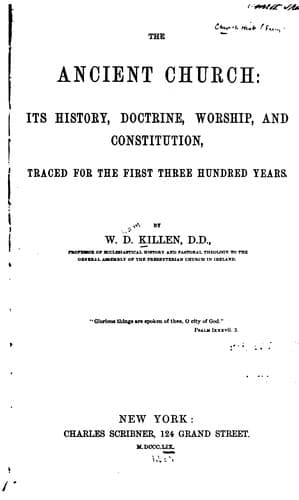
The Ancient Church: Its History, Doctrine, Worship, and ConstitutionKillen, W. D. (William Dool)
Religion
The Ancient Church: Its History, Doctrine, Worship, and Constitution
Killen, W. D. (William Dool)
Church history -- Primitive and early church, ca. 30-600
infinitely more important than any of the passing interests of time;
that they had, verily, a commission from heaven to teach the way of
eternal salvation; and that he and others, who had taken part in their
imprisonment, had acted most iniquitously. For what now could be more
evident than that the apostles were the servants of the Most High God?
When everything around them was enveloped in the gloom of midnight, they
seemed able to tell what was passing all over the prison. How strange
that, when the jailer was about to kill himself, a voice should issue
from a different apartment saying--Do thyself no harm! How strange that
the very man whose feet, a few hours before, had boon made fast in the
stocks, should now be the giver of this friendly counsel! How remarkable
that, when all the doors were opened, no one attempted to escape! And
how extraordinary that, during the very night on which the apostles were
imprisoned, the bands of all the inmates were loosed, and that the
building was made to rock to its foundations! Did not the earthquake
indicate that He, whom the apostles served, was able to save and to
destroy? Did it not proclaim, trumpet-tongued, that He would surely
punish their persecutors? When the jailer thought on these things, well
might he be paralysed with fear, and believing that the apostles alone
could tell him how he was Lo obtain relief from the anxiety which
oppressed his spirit, it is not strange that "he called for a light, and
sprang in, and came trembling, and fell down before Paul and Silas, and
brought them out, and said--Sirs, what must I do to be saved?" [96:1]
The missionaries were prepared with a decisive reply to this earnest
inquiry, and it is probable that their answer took the jailer by
surprise. He expected, perhaps, to be called upon to do something,
either to propitiate the apostles themselves, or to turn away the wrath
of the God of the apostles. It is obvious, from the spirit which he
manifested, that, to obtain peace of conscience, he was ready to go very
far in the way of self-sacrifice. He may have been willing to part with
his property, or to imperil his life, or to give "the fruit of his body
for the sin of his soul." What, then, must have been his astonishment
when he found that the divine mercy so far transcended anything he could
have possibly anticipated! With what satisfaction must he have listened
to the assurance that an atonement had already been made, and that the
sinner is safe as soon as he lays the hand of faith on the head of the
great Sacrifice! What delight must he have experienced when informed
that unbelief alone could shut him out from heaven; that the Son of God
had died the just for the unjust; and that this almighty Saviour now
waited to be gracious to-himself! How must the words of the apostles
have thrilled through his soul, as he heard them repeating the
invitation-"Believe on the Lord Jesus Christ, and thou shalt be saved,
and thy house." [97:1]
Public-domain text, read in full here on John Shaqi.
Reviews
Reviews
No reviews yet
Be the first to share your thoughts on this work.
Elsewhere in the archive
Join the Discussion
Join the discussion
Sign in to leave a comment or review.
Sign InorCreate an account