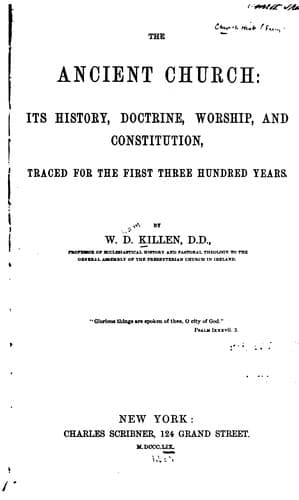
The Ancient Church: Its History, Doctrine, Worship, and ConstitutionKillen, W. D. (William Dool)
Religion
The Ancient Church: Its History, Doctrine, Worship, and Constitution
Killen, W. D. (William Dool)
Church history -- Primitive and early church, ca. 30-600
On the whole Paul and Silas had reason to thank God and take courage,
when they reviewed their progress in the first European city which they
visited. Though they had met with much opposition, their ministry had
been greatly blessed; and, in the end, the magistrates, who had treated
them with much severity, had felt it necessary to apologise. The
extraordinary circumstances accompanying their imprisonment must have
made their case known to the whole body of the citizens, and thus
secured a degree of attention to their preaching which could not have
been otherwise expected. The Church, now established at Philippi,
contained a number of most generous members, and Paul afterwards
gratefully acknowledged the assistance he received from them. "Ye have
well done," said he, "that ye did communicate with my affliction. Now,
ye Philippians, know also, that in the beginning of the gospel, when I
departed from Macedonia, no church communicated with me, as concerning
giving and receiving, but ye only. For, even in Thessalonica, ye sent
once and again unto my necessity." [99:3]
CHAPTER VII.
THE MINISTRY OF PAUL IN THESSALONICA, BEREA, ATHENS,
AND CORINTH.
A.D. 52 TO A.D. 54.
After leaving Philippi, and passing through Amphipolis and Apollonia,
Paul made his way to Thessalonica. In this city there was a Jewish
synagogue where he was permitted, for three successive Sabbaths, to
address the congregation. His discourses produced a powerful impression;
as some of the seed of Abraham believed, "and, of the devout Greeks, a
great multitude, and of the chief women, not a few." [100:1] The
unbelieving Jews attempted to create annoyance by representing the
missionaries as acting "contrary to the decrees of Caesar, saying--that
there is another king, one Jesus;" [100:2] but though they contrived to
trouble "the rulers" [100:3] and to "set all the city in an uproar,"
they could not succeed in preventing the formation of a flourishing
Christian community. Paul appeared next in Berea, and, when reporting
his success here, the sacred historian bears a remarkable testimony to
the right of the laity to judge for themselves as to the meaning of the
Book of Inspiration; for he states that the Jews of this place "were
_more noble_ than those in Thessalonica, in that they received the word
with all readiness of mind, and _searched the scriptures daily"_ [101:1]
to ascertain the truth of the apostolic doctrine. Paul now proceeded "to
go as it were to the sea," and soon afterwards arrived at Athens.
Public-domain text, read in full here on John Shaqi.
Reviews
Reviews
No reviews yet
Be the first to share your thoughts on this work.
Elsewhere in the archive
Join the Discussion
Join the discussion
Sign in to leave a comment or review.
Sign InorCreate an account