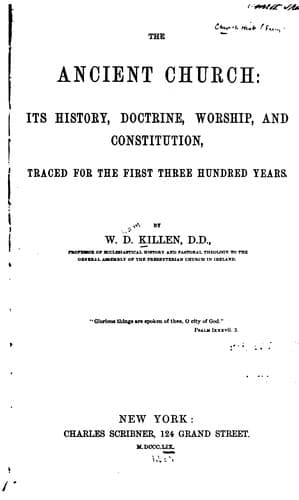
The Ancient Church: Its History, Doctrine, Worship, and ConstitutionKillen, W. D. (William Dool)
Religion
The Ancient Church: Its History, Doctrine, Worship, and Constitution
Killen, W. D. (William Dool)
Church history -- Primitive and early church, ca. 30-600
be put down either by irony or insult; and at length it was found
necessary to allow him a fair opportunity of explaining his principles.
It is accordingly stated that "they took him and brought him unto Mars
Hill saying--May we know what this new doctrine, whereof thou speakest,
is, for thou bringest certain strange things to our ears--we would know,
therefore, what these things mean." [103:2]
The speech delivered by Paul on this memorable occasion has been often
admired for its tact, vigour, depth, and fidelity. Whilst giving the
Athenians full credit for their devotional feeling, and avoiding any
pointed and sarcastic attack on the absurdities of their religious
ritual, he contrives to present such an outline of the prominent
features of the Christian revelation, as might have convinced any candid
and intelligent auditor of its incomparable superiority, as well to the
doctrines of the philosophers, as to the fables of heathenism. In the
very commencement of his observations he displays no little address. "Ye
men of Athens," said he, "I perceive that, in every point of view, ye
are carrying your religious reverence very far; for, as I passed by, and
observed the objects of your worship, I found an altar with this
inscription--To the unknown God--whom, therefore, ye worship, though ye
know him not, him declare I unto you." [104:1] The existence in this
city of inscriptions, such as that here given, is attested by several
other ancient witnesses [104:2] as well as Paul, and the altars thus
distinguished appear to have been erected when the place was afflicted
by certain strange and unprecedented calamities which the deities,
already recognised, were supposed to be unable to remove. The auditors
of the apostle could not well be dissatisfied with the statement that
they carried their "religious reverence very far;" and yet, perhaps,
they were scarcely prepared for the reference to this altar by which the
observation was illustrated; for the inscription which he quoted
contained a most humiliating confession of their ignorance, and
furnished him with an excellent apology for proposing to act as their
theological instructor.
Public-domain text, read in full here on John Shaqi.
Reviews
Reviews
No reviews yet
Be the first to share your thoughts on this work.
Elsewhere in the archive
Join the Discussion
Join the discussion
Sign in to leave a comment or review.
Sign InorCreate an account