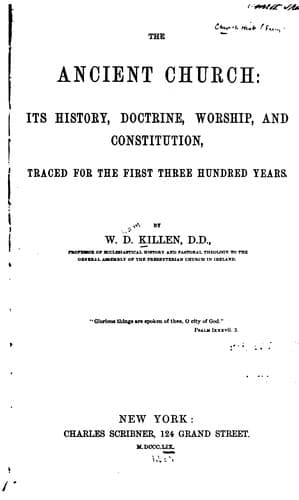
The Ancient Church: Its History, Doctrine, Worship, and ConstitutionKillen, W. D. (William Dool)
Religion
The Ancient Church: Its History, Doctrine, Worship, and Constitution
Killen, W. D. (William Dool)
Church history -- Primitive and early church, ca. 30-600
His discourse, which treats of the Being and Attributes of God, must
have been heard with no ordinary interest by the polite and intelligent
Athenians. Its reasoning is plain, pertinent, and powerful; and whilst
adopting a didactic tone, and avoiding the language and spirit of
controversy, the apostle, in every sentence, comes into direct
collision, either with the errors of polytheism, or the dogmas of the
Grecian philosophy. The Stoics were Pantheists, and held the doctrine of
the eternity of matter; [105:1] whilst the Epicureans maintained that
the universe arose out of a fortuitous concurrence of atoms; [105:2] and
therefore Paul announced his opposition to both these sects when he
declared that "God made the world and all things therein." [105:3] The
Athenians boasted that they were of nobler descent than the rest of
their countrymen; [105:4] and the heathen generally believed that each
nation belonged to a distinct stock and was under the guardianship of
its own peculiar deities; but the apostle affirmed that "God hath made
_of one blood_ all nations of men to dwell on all the face of the
earth." [105:5] The Epicureans asserted that the gods did not interfere
in the concerns of the human family, and that they were destitute of
foreknowledge; but Paul here assured them that the great Creator "giveth
to all life and breath and all things," and "hath determined the times
before appointed, and the bounds of their habitation." [105:6] The
heathen imagined that the gods inhabited their images; but whilst Paul
was ready to acknowledge the excellence, as works of art, of the statues
which he saw all around him, he at the same time distinctly intimated
that these dead pieces of material mechanism could never even faintly
represent the glory of the invisible First Cause, and that they were
unworthy the homage of living and intellectual beings. "As we are the
offspring of God," said he, "we ought not to think that the Godhead is
like unto gold, or silver, or stone, graven by art and man's device."
[106:1] After having thus borne testimony to the spirituality of the I
am that I am, and asserted His authority as the Maker and Preserver of
the world, Paul proceeded to point out his claims as its righteous
Governor. "He hath appointed a day, in the which he will judge the world
in righteousness by that man whom he hath ordained, whereof he hath
given assurance unto all men in that he hath raised him from the dead."
[106:2] The pleasure-loving Epicureans refused to believe in a future
state of rewards and punishments; and concurred with the Stoics in
denying the immortality of the soul. [106:3] Both these parties were, of
course, prepared to reject the doctrine of a general judgment. The idea
of the resurrection of the body was quite novel to almost all classes of
the Gentiles; and, when at first propounded to the Athenians, was
received, by many, with doubt, and by some, with ridicule. "When they
Public-domain text, read in full here on John Shaqi.
Reviews
Reviews
No reviews yet
Be the first to share your thoughts on this work.
Elsewhere in the archive
Join the Discussion
Join the discussion
Sign in to leave a comment or review.
Sign InorCreate an account