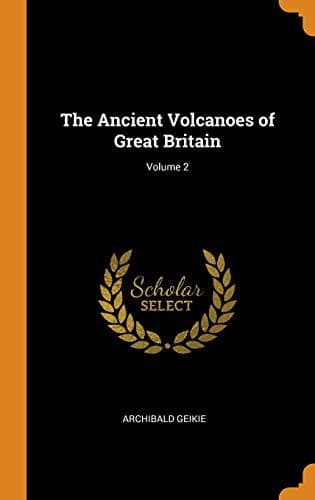
The Ancient Volcanoes of Great Britain, Volume 2 (of 2)Geikie, Archibald
Science
The Ancient Volcanoes of Great Britain, Volume 2 (of 2)
Geikie, Archibald
Volcanoes -- Great Britain
His views were published as far back as 1778, three years after
Hutton read the first outline of his theory of the earth and made
known his observations regarding the igneous origin of whinstones.[20]
The first detailed account of the Derbyshire eruptive rocks was that
given by Fairey,[21] which has served as the basis of all subsequent
descriptions. Conybeare, in particular, prepared a succinct narrative
from Fairey's more diffuse statements, and thus placed clearly
before geologists the nature and distribution of these volcanic
intercalations.[22] Subsequently the district was mapped by De la Beche
and the officers of the Geological Survey, and the areas occupied by
the several outcrops of igneous rock could then be readily seen.[23]
[Footnote 20: _Trans. Roy. Soc. Edin._ i. p. 275, _et seq._ Hutton
specially mentions the toadstone of Derbyshire as one of the rocks
produced by fusion, p. 277.]
[Footnote 21: _General View of the Agriculture and Minerals of
Derbyshire_ (1811).]
[Footnote 22: _Outlines of the Geology of England and Wales_ (1822), p.
448.]
[Footnote 23: See Sheets 71 N.W., 72 N.E., 81 N.E. and S.E. and 82 S.W.
of the Geological Survey of England and Wales.]
Though the "toadstones" were believed to form definite platforms among
the limestone strata, and thus to be capable of being used as reliable
horizons in the mineral fields of Derbyshire, they appear to have
been generally regarded as intrusive sheets like the Whin Sill of the
north. Thus De la Beche in his _Manual of Geology_, giving a summary
of what was known at the time regarding intercalated igneous rocks,
remarks with regard to the Derbyshire toadstones that they may from
all analogy be considered to have been injected among the limestones
which would be easily separated by the force of the intruded igneous
material.[24] But the same observer, after his experience among the
ancient volcanic rocks of Devonshire, came fully to recognize the
proofs of contemporaneous outflow among the Derbyshire toadstones. In
his subsequently published _Geological Observer_, he described the
toadstones as submarine lavas that had been poured out over the floor
of the sea in which the Carboniferous Limestone was deposited, and had
been afterwards covered up under fresh deposits of limestone.[25] It is
remarkable, however, that he specially comments on the absence, as he
believed, of any contemporaneously ejected ashes and lapilli, such as
occur in Devonshire. That true tuffs or volcanic ashes are associated
with the toadstones was noticed by Jukes in 1861,[26] and afterwards by
the Geological Survey.[27] Since that time geologists have generally
recognized these Derbyshire igneous rocks as truly contemporaneous
intercalations. But very little has recently been written on the
structure of the district, our information regarding it being still
based mainly on the early observations of Fairey and the mapping of the
Geological Survey.
[Footnote 24: _Manual_, 3rd edit. 1833, p. 462.]
Public-domain text, read in full here on John Shaqi.
Reviews
Reviews
No reviews yet
Be the first to share your thoughts on this work.
Join the Discussion
Join the discussion
Sign in to leave a comment or review.
Sign InorCreate an account