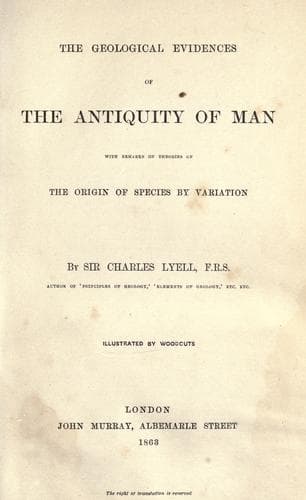
Evolution (Biology); Glacial epoch; Human beings -- Origin; Human evolution
There had been many a shipwreck, and many a naval fight in those waters,
and hundreds of Dutch and Spanish soldiers and sailors had met there
with a watery grave. The population which lived on the borders of this
ancient sheet of water numbered between thirty and forty thousand souls.
In digging the great canal, a fine section had been laid open, about 30
miles long, of the deposits which formed the ancient bottom of the lake.
Trenches, also, innumerable, several feet deep, had been freshly dug on
all the farms, and their united length must have amounted to thousands
of miles. In some of the sandy soil recently thrown out of the trenches,
I observed specimens of freshwater and brackish-water shells, such as
Unio and Dreissena, of living species; and in clay brought up from below
the sand, shells of Tellina, Lutraria, and Cardium, all of species now
inhabiting the adjoining sea.
As the Dreissena is believed by conchologists to have been introduced
into Western Europe in very modern times, brought with foreign timber
in the holds of vessels from the rivers flowing into the Black Sea, the
layer of sand containing it in the Haarlem lake is probably not more
than a hundred years old.
One or two wrecked Spanish vessels, and arms of the same period, have
rewarded the antiquaries who had been watching the draining operations
in the hope of a richer harvest, and who were not a little disappointed
at the result. In a peaty tract on the margin of one part of the lake a
few coins were dug up; but if history had been silent, and if there had
been a controversy whether Man was already a denizen of this planet
at the time when the area of the Haarlem lake was under water, the
archaeologist, in order to answer this question, must have appealed,
as in the case of the valley of the Somme, not to fossil bones, but to
works of art embedded in the superficial strata.
Mr. Staring, in his valuable memoir on the "Geological Map of Holland,"
has attributed the general scarcity of human bones in Dutch peat,
notwithstanding the many works of art preserved in it, to the power of
the humic and sulphuric acids to dissolve bones, the peat in question
being plentifully impregnated with such acids. His theory may be
correct, but it is not applicable to the gravel of the valley of the
Somme, in which the bones of fossil mammalia are frequent, nor to the
uppermost freshwater strata forming the bottom of a large part of the
Haarlem Lake, in which it is not pretended that such acids occur.
Public-domain text, read in full here on John Shaqi.
Reviews
Reviews
No reviews yet
Be the first to share your thoughts on this work.
Elsewhere in the archive
Join the Discussion
Join the discussion
Sign in to leave a comment or review.
Sign InorCreate an account