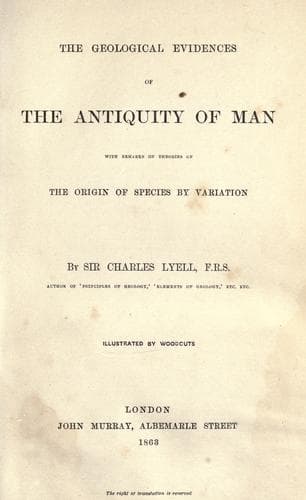
Evolution (Biology); Glacial epoch; Human beings -- Origin; Human evolution
The primitive inhabitants of the valley of the Somme may have been too
wary and sagacious to be often surprised and drowned by floods, which
swept away many an incautious elephant or rhinoceros, horse and ox. But
even if those rude hunters had cherished a superstitious veneration for
the Somme, and had regarded it as a sacred river (as the modern Hindoos
revere the Ganges), and had been in the habit of committing the bodies
of their dead or dying to its waters--even had such funeral rites
prevailed, it by no means follows that the bones of many individuals
would have been preserved to our time.
A corpse cast into the stream first sinks, and must then be almost
immediately overspread with sediment of a certain weight, or it will
rise again when distended with gases, and float perhaps to the sea
before it sinks again. It may then be attacked by fish of marine
species, some of which are capable of digesting bones. If, before being
carried into the sea and devoured, it is enveloped with fluviatile mud
and sand, the next flood, if it lie in mid-channel, may tear it out
again, scatter all the bones, roll some of them into pebbles, and
leave others exposed to destroying agencies; and this may be repeated
annually, till all vestiges of the skeleton may disappear. On the other
hand, a bone washed through a rent into a subterranean cavity, even
though a rarer contingency, may have a greater chance of escaping
destruction, especially if there be stalactite dropping from the roof of
the cave or walls of a rent, and if the cave be not constantly traversed
by too strong a current of engulfed water.
CHAPTER 9. -- WORKS OF ART IN PLEISTOCENE ALLUVIUM OF FRANCE AND
ENGLAND.
Flint Implements in ancient Alluvium of the Basin of the Seine.
Bones of Man and of extinct Mammalia in the Cave of Arcy.
Extinct Mammalia in the Valley of the Oise.
Flint Implement in Gravel of same Valley.
Works of Art in Pleistocene Drift in Valley of the Thames.
Musk Ox.
Meeting of northern and southern Fauna.
Migrations of Quadrupeds.
Mammals of Mongolia.
Chronological Relation of the older Alluvium of the Thames to the
Glacial Drift.
Flint Implements of Pleistocene Period in Surrey, Middlesex, Kent,
Bedfordshire, and Suffolk.
FLINT IMPLEMENTS IN PLEISTOCENE ALLUVIUM IN THE BASIN OF THE SEINE.
In the ancient alluvium of the valleys of the Seine and its principal
tributaries, the same assemblage of fossil animals, which has been
alluded to in the last chapter as characterising the gravel of Picardy,
has long been known; but it was not till the year 1860, and when
diligent search had been expressly made for them, that flint implements
of the Amiens type were discovered in this part of France.
In the neighbourhood of Paris deposits of drift occur answering both to
those of the higher and lower levels of the basin of the Somme before
described.*
(* Prestwich, "Proceedings of the Royal Society" 1862.)
Public-domain text, read in full here on John Shaqi.
Reviews
Reviews
No reviews yet
Be the first to share your thoughts on this work.
Elsewhere in the archive
Join the Discussion
Join the discussion
Sign in to leave a comment or review.
Sign InorCreate an account