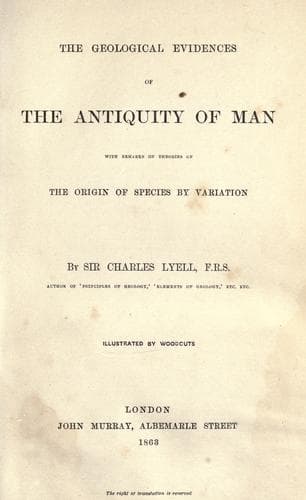
Evolution (Biology); Glacial epoch; Human beings -- Origin; Human evolution
In the north of Europe, along the borders of the Baltic, where the
boulder formation is continuous for hundreds of miles east and west, it
has been long known that the erratic blocks, often of very large size,
are of northern origin. Some of them have come from Norway and Sweden,
others from Finland, and their present distribution implies that they
were carried southwards, for a part at least of their way, by floating
ice, at a time when much of the area over which they are scattered was
under water. But it appears from the observations of Boetlingk, in
1840, and those of more recent inquirers, that while many blocks have
travelled to the south, others have been carried northwards, or to the
shores of the Polar Sea, and others north-eastward, or to those of
the White Sea. In fact, they have wandered towards all points of
the compass, from the mountains of Scandinavia as a centre, and the
rectilinear furrows imprinted by them on the polished surfaces of the
mountains where the rocks are hard enough to retain such markings,
radiate in all directions, or point outwards from the highest land, in a
manner corresponding to the course of the erratics above mentioned.*
(* Sir R.I. Murchison, in his "Russia and the Ural
Mountains" (1845) has indicated on a map not only the
southern limits of the Scandinavian drift, but by arrows the
direction in which "it proceeded eccentrically from a common
central region.")
Before the glacial theory was adopted, the Swedish and Norwegian
geologists speculated on a great flood, or the sudden rush of an
enormous body of water charged with mud and stones, descending from the
central heights or watershed into the adjoining lower lands. The erratic
blocks were supposed in their downward passage to have smoothed and
striated the rock surfaces over which they were forced along.
It would be a waste of time, in the present state of science, to
controvert this hypothesis, as it is now admitted that even if the rush
of a diluvial current, invented for the occasion and wholly without
analogy in the known course of nature, be granted, it would be
inadequate to explain the uniformity, parallelism, persistency,
and rectilinearity of the so-called glacial furrows. It is moreover
ascertained that heavy masses of rock, not fixed in ice, and moving as
freely as they do when simply swept along by a muddy current, do not
give rise to such scratches and furrows.
M. Kjerulf of Christiania, in a paper lately communicated to the
Geological Society of Berlin,* has objected, and perhaps with reason,
to what he considers the undue extent to which I have, in some of
my writings, supposed the mountains of northern Europe, to have been
submerged during the glacial period.
(* "Zeitschrift der Deutschen Geologischen Gesellschaft"
Berlin 1860.)
Public-domain text, read in full here on John Shaqi.
Reviews
Reviews
No reviews yet
Be the first to share your thoughts on this work.
Elsewhere in the archive
Join the Discussion
Join the discussion
Sign in to leave a comment or review.
Sign InorCreate an account