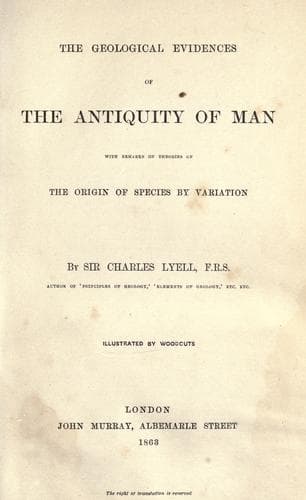
Evolution (Biology); Glacial epoch; Human beings -- Origin; Human evolution
He remarks that the signs of glacial action on the Scandinavian
mountains ascend as high as 6000 feet, whereas fossil marine shells of
the same period never reach elevations exceeding 600 feet. The land, he
says, may have been much higher than it now is, but it has evidently not
been much lower since the commencement of the glacial period, or marine
shells would be traceable to more elevated points. In regard to the
absence of marine shells, I shall point out in the sequel how small is
the dependence we can place on this kind of negative evidence, if we
desire to test by it the extent to which the land has been submerged.
I cannot therefore consent to limit the probable depression and
re-elevation of Scandinavia to 600 feet. But that the larger part of
the glaciation of that country has been supramarine, I am willing to
concede. In support of this view M. Kjerulf observes that the direction
of the furrows and striae, produced by glacial abrasion, neither
conforms to a general movement of floating ice from the Polar regions,
nor to the shape of the existing valleys, as it would do if it had been
caused by independent glaciers generated in the higher valleys after
the land had acquired its actual shape. Their general arrangement and
apparent irregularities are, he contends, much more in accordance with
the hypothesis of there having been at one time a universal covering
of ice over the whole of Norway and Sweden, like that now existing in
Greenland, which, being annually recruited by fresh falls of snow,
was continually pressing outwards and downwards to the coast and lower
regions, after crossing many of the lower ridges, and having no relation
to the minor depressions, which were all choked up with ice and reduced
to one uniform level.
CONTINENTAL ICE OF GREENLAND.
In support of this view, he appeals to the admirable description of
the continental ice of Greenland, lately published by Dr. H. Rink of
Copenhagen,* who resided three or four years in the Danish settlements
in Baffin's Bay, on the west coast of Greenland, between latitudes 69
and 73 degrees north.
(* "Journal of Royal Geographical Society" volume 23 1853
page 145.)
Public-domain text, read in full here on John Shaqi.
Reviews
Reviews
No reviews yet
Be the first to share your thoughts on this work.
Elsewhere in the archive
Join the Discussion
Join the discussion
Sign in to leave a comment or review.
Sign InorCreate an account