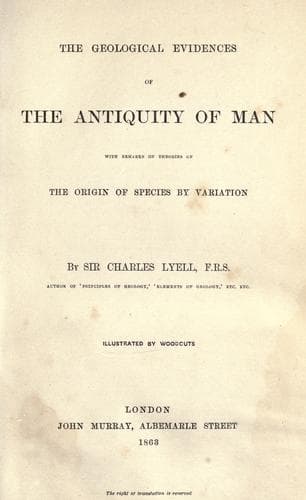
Evolution (Biology); Glacial epoch; Human beings -- Origin; Human evolution
We may presume with more confidence that when the Alps were highest
and the Alpine glaciers most developed, filling all the great lakes of
northern Italy and loading the plains of Piedmont and Lombardy with
ice, the waters of the Mediterranean were chilled and of a lower average
temperature than now. Such a period of refrigeration is required by the
conchologist to account for the prevalence of northern shells in the
Sicilian seas about the close of the Pliocene or commencement of the
Pleistocene period. For such shells as Cyprina islandica, Panopoea
norvegica (= P. bivonae, Philippi), Leda pygmaea, Munst, and some
others, enumerated among the fossils of the latest Tertiary formations
of Sicily by Philippi and Edward Forbes, point unequivocally to a former
more severe climate. Dr. Hooker also in his late journey to Syria (in
the autumn of 1860) found the moraines of extinct glaciers, on which the
whole of the ancient cedars of Lebanon grow, to descend 4000 feet below
the summit of that chain. The temperature of Syria is now so much milder
that there is no longer perpetual snow even on the summit of Lebanon,
the height of which was ascertained to be 10,200 feet above the
Mediterranean.*
(* Hooker, "Natural History Review" Number 5 January 1862
page 11.)
Such monuments of a cold climate in latitudes so far south as Syria and
the north of Sicily, between 33 and 38 degrees north, may be confidently
referred to an early part of the glacial period, or to times long
anterior to those of Man and the extinct mammalia of Abbeville and
Amiens.
CHAPTER 16. -- HUMAN REMAINS IN THE LOESS, AND THEIR PROBABLE AGE.
Nature, Origin, and Age of the Loess of the Rhine and Danube.
Impalpable Mud produced by the Grinding Action of Glaciers.
Dispersion of this Mud at the Period of the Retreat of the
great Alpine Glaciers.
Continuity of the Loess from Switzerland to the Low Countries.
Characteristic Organic Remains not Lacustrine.
Alpine Gravel in the Valley of the Rhine covered by Loess.
Geographical Distribution of the Loess and its Height above the Sea.
Fossil Mammalia.
Loess of the Danube.
Oscillations in the Level of the Alps and lower Country required to
explain the Formation and Denudation of the Loess.
More rapid Movement of the Inland Country.
The same Depression and Upheaval might account for the Advance
and Retreat of the Alpine Glaciers.
Himalayan Mud of the Plains of the Ganges compared to
European Loess.
Human Remains in Loess near Maestricht, and their probable
Antiquity.
NATURE AND ORIGIN OF THE LOESS.
Public-domain text, read in full here on John Shaqi.
Reviews
Reviews
No reviews yet
Be the first to share your thoughts on this work.
Elsewhere in the archive
Join the Discussion
Join the discussion
Sign in to leave a comment or review.
Sign InorCreate an account