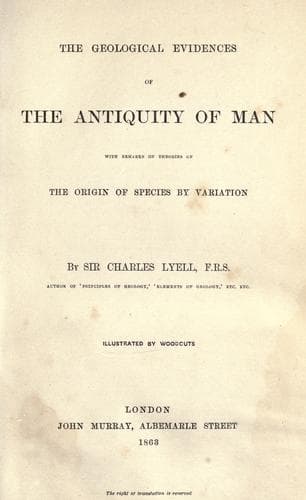
Evolution (Biology); Glacial epoch; Human beings -- Origin; Human evolution
(* "Proceedings of the Geological Society" 1845 volume 4
page 94.)
To pass to another and very remote part of the world, we have witnessed
so late as January 1855 in the northern island of New Zealand a sudden
and permanent rise of land on the northern shores of Cook's Straits,
which at one point, called Muko-muka, was so unequal as to amount to
9 feet vertically, while it declined gradually from this maximum of
upheaval in a distance of about 23 miles north-west of the greatest
rise, to a point where no change of level was perceptible. Mr. Edward
Roberts of the Royal Engineers, employed by the British Government
at the time of the shock in executing public works on the coast,
ascertained that the extreme upheaval of certain ancient rocks followed
a line of fault running at least 90 miles from south to north into the
interior; and what is of great geological interest, immediately to the
east of this fault the country, consisting of Tertiary strata, remained
unmoved or stationary; a fact well established by the position of a line
of Nullipores marking the sea-level before the earthquake, both on the
surface of the Tertiary and Palaeozoic rocks.*
(* "Bulletin de la Societe Geologique de France" volume 13
1856 page 660, where I have described the facts communicated
to me by Messrs. Roberts and Walter Mantell.)
The repetition of such unequal movements, especially if they recurred at
intervals along the same lines of fracture, would in the course of ages
cause the strata to dip at a high angle in one direction, while towards
the opposite point of the compass they would terminate abruptly in a
steep escarpment.
But it is probable that the multiplication of such movements in the
post-Tertiary period has rarely been so great as to produce results like
those above described in Moen, for the principal movements in any given
period seem to be of a more uniform kind, by which the topography of
limited districts and the position of the strata are not visibly altered
except in their height relatively to the sea. Were it otherwise we
should not find conformable strata of all ages, including the primary
fossiliferous of shallow-water origin, which must have remained
horizontal throughout vast areas during downward movements of several
thousand feet going on at the period of their accumulation. Still less
should we find the same primary strata, such as the Carboniferous,
Devonian, or Silurian, still remaining horizontal over thousands of
square leagues, as in parts of North America and Russia, having escaped
dislocation and flexure throughout the entire series of epochs
which separate Palaeozoic from Recent times. Not that they have been
motionless, for they have undergone so much denudation, and of such
a kind, as can only be explained by supposing the strata to have been
subjected to great oscillations of level, and exposed in some cases
repeatedly to the destroying and planing action of the waves of the sea.
Public-domain text, read in full here on John Shaqi.
Reviews
Reviews
No reviews yet
Be the first to share your thoughts on this work.
Elsewhere in the archive
Join the Discussion
Join the discussion
Sign in to leave a comment or review.
Sign InorCreate an account