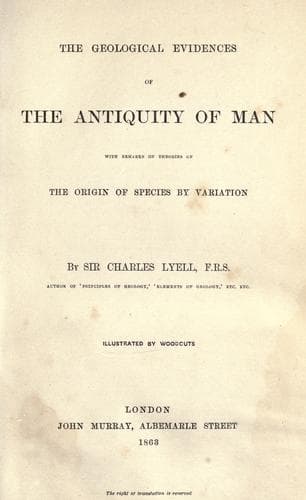
Evolution (Biology); Glacial epoch; Human beings -- Origin; Human evolution
It seems probable that the successive convulsions in Moen were
contemporary with those upward and downward movements of the glacial
period which were described in the thirteenth and some of the following
chapters, and that they ended before the upper beds of Number 5, Figure
49, with its large erratic blocks, were deposited, as some of those
beds occurring in the disturbed parts of Moen appear to have escaped the
convulsions to which Numbers 2, 3, and 4 were subjected. If this be so,
the whole derangement, although Pleistocene, may have been anterior to
the human epoch, or rather to the earliest date to which the existence
of man has as yet been traced back.
CHAPTER 18. -- THE GLACIAL PERIOD IN NORTH AMERICA.
Post-glacial Strata containing Remains of Mastodon giganteus
in North America.
Scarcity of Marine Shells in Glacial Drift of Canada and the
United States.
Greater southern Extension of Ice-action in North America
than in Europe.
Trains of Erratic Blocks of vast Size in Berkshire, Massachusetts.
Description of their Linear Arrangement and Points of Departure.
Their Transportation referred to Floating and Coast Ice.
General Remarks on the Causes of former Changes of Climate at
successive geological Epochs.
Supposed Effects of the Diversion of the Gulf Stream in a
Northerly instead of North-Easterly Direction.
Development of extreme Cold on the opposite Sides of the Atlantic
in the Glacial period not strictly simultaneous.
Effect of Marine Currents on Climate.
Pleistocene Submergence of the Sahara.
On the North American continent, between the arctic circle and the 42nd
parallel of latitude, we meet with signs of ice-action on a scale as
grand as, if not grander than, in Europe; and there also the excess of
cold appears to have been first felt at the close of the Tertiary, and
to have continued throughout a large portion of the Pleistocene period.
[36]
The general absence of organic remains in the North American glacial
formation makes it as difficult as in Europe to determine what mammalia
lived on the continent at the time of the most intense refrigeration, or
when extensive areas were becoming strewed over with glacial drift and
erratic blocks, but it is certain that a large proboscidean now extinct,
the Mastodon giganteus, Cuv., together with many other quadrupeds, some
of them now living and others extinct, played a conspicuous part in the
post-glacial era. By its frequency as a fossil species, this pachyderm
represents the European Elephas primigenius, although the latter also
occurs fossil in the United States and Canada, and abounds, as I learn
from Sir John Richardson, in latitudes farther north than those to which
the mastodon has been traced.
Public-domain text, read in full here on John Shaqi.
Reviews
Reviews
No reviews yet
Be the first to share your thoughts on this work.
Elsewhere in the archive
Join the Discussion
Join the discussion
Sign in to leave a comment or review.
Sign InorCreate an account