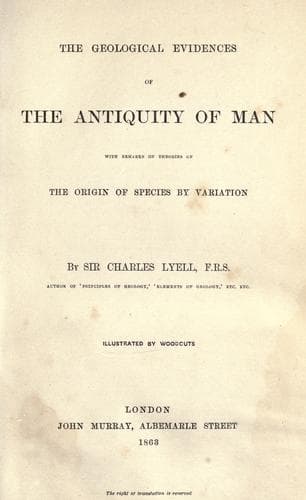
Evolution (Biology); Glacial epoch; Human beings -- Origin; Human evolution
All geologists acquainted with the district now under consideration are
agreed that the mountain ranges A, B, and c, as well as the adjoining
valleys, had assumed their actual form and position before the drift and
erratics accumulated on and in them and before the surface of the fixed
rocks was polished and furrowed. I have the less hesitation in ascribing
the transporting power to coast-ice, because I saw in 1852 an angular
block of sandstone, 8 feet in diameter, which had been brought down
several miles by ice only three years before to the mouth of the
Petitcodiac estuary, in Nova Scotia, where it joins the Bay of Fundy;
and I ascertained that on the shores of the same bay, at the South
Joggins, in the year 1850, much larger blocks had been removed by
coast-ice, and after they had floated half a mile, had been dropped in
salt water by the side of a pier built for loading vessels with coal,
so that it was necessary at low tide to blast these huge ice-borne
rocks with gunpowder in order that the vessels might be able to draw up
alongside the pier. These recent exemplifications of the vast carrying
powers of ice occurred in latitude 46 degrees north (corresponding to
that of Bordeaux), in a bay never invaded by icebergs.
I may here remark that a sheet of ice of moderate thickness, if it
extend over a wide area, may suffice to buoy up the largest erratics
which fall upon it. The size of these will depend, not on the intensity
of the cold but on the manner in which the rock is jointed, and the
consequent dimensions of the blocks into which it splits when falling
from an undermined cliff.
When I first endeavoured in the "Principles of Geology" in 1830,* to
explain the causes, both of the warmer and colder climates which have
at former periods prevailed on the globe, I referred to successive
variations in the height and position of the land and its extent
relatively to the sea in polar and equatorial latitudes--also to
fluctuations in the course of oceanic currents and other geographical
conditions, by the united influence of which I still believe the
principal revolutions in the meteorological state of the atmosphere at
different geological periods have been brought about.
(* 1st edition chapter 7; 9th edition ibid.)
The Gulf Stream was particularly alluded to by me as moderating the
winter climate of northern Europe and as depending for its direction
on temporary and accidental peculiarities in the shape of the land,
especially that of the narrow Straits of Bahama, which a slight
modification in the earth's crust would entirely alter.
Mr. Hopkins, in a valuable essay on the causes of former changes of
climate,*nhas attempted to calculate how much the annual temperature of
Europe would be lowered if this Gulf Stream were turned in some other
and new direction, and estimates the amount at about six or seven
degrees of Fahrenheit.
(* Hopkins, "Quarterly Journal of the Geological Society"
volume 8 1852 page 56.)
Public-domain text, read in full here on John Shaqi.
Reviews
Reviews
No reviews yet
Be the first to share your thoughts on this work.
Elsewhere in the archive
Join the Discussion
Join the discussion
Sign in to leave a comment or review.
Sign InorCreate an account