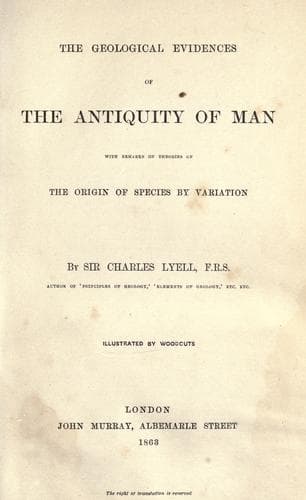
Evolution (Biology); Glacial epoch; Human beings -- Origin; Human evolution
He also supposes that if at the same time a considerable part of
northern and central Europe were submerged, so that a cold current from
the arctic seas should sweep over it, an additional refrigeration of
three or four degrees would be produced. He has speculated in the
same essay on the effects which would be experienced in the eastern
hemisphere if the same mighty current of warm water, instead of crossing
the Atlantic, were made to run northwards from the Gulf of Mexico
through the region now occupied by the valley of the Mississippi, and so
onwards to the arctic regions.
After reflecting on what has been said in the thirteenth chapter of
the submergence and re-elevation of the British Isles and the adjoining
parts of Europe, and the rising and sinking of the Alps and the
basins of some of the great rivers flowing from that chain, since the
commencement of the glacial period, a geologist will not be disposed to
object to the theory above adverted to, on the score of its demanding
too much conversion of land into sea, or almost any amount of
geographical change in Pleistocene times. But a difficulty of another
kind presents itself. We have seen that, during the glacial period, the
cold in Europe extended much farther south than it does at present, and
in this chapter we have demonstrated that in North America the cold also
extended no less than 10 degrees of latitude still farther southwards
than in Europe; so that if a great body of heated water, instead of
flowing north-eastward, were made to pass through what is now the centre
of the American continent towards the Arctic Circle, it could not
fail to mitigate the severity of the winter's cold in precisely those
latitudes where the cold was greatest and where it has left monuments
of ice-action surpassing in extent any exhibited on the European side of
the ocean.
Public-domain text, read in full here on John Shaqi.
Reviews
Reviews
No reviews yet
Be the first to share your thoughts on this work.
Elsewhere in the archive
Join the Discussion
Join the discussion
Sign in to leave a comment or review.
Sign InorCreate an account