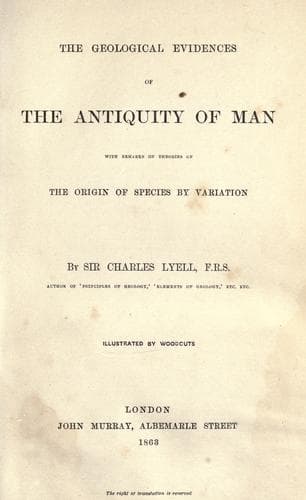
Evolution (Biology); Glacial epoch; Human beings -- Origin; Human evolution
Recapitulation of Results arrived at in the earlier Chapters.
Ages of Stone and Bronze.
Danish Peat and Kitchen-Middens.
Swiss Lake-Dwellings.
Local Changes in Vegetation and in the wild and domesticated
Animals and in Physical Geography coeval with the Age of
Bronze and the later Stone Period.
Estimates of the positive Date of some Deposits of the later
Stone Period.
Ancient Division of the Age of Stone of St. Acheul and Aurignac.
Migrations of Man in that Period from the Continent to England
in Post-Glacial Times.
Slow Rate of Progress in barbarous Ages.
Doctrine of the superior Intelligence and Endowments of the
original Stock of Mankind considered.
Opinions of the Greeks and Romans, and their Coincidence with
those of the Modern Progressionist.
The ages of stone and bronze, so called by archaeologists, were spoken
of in the earlier chapters of this work. That of bronze has been traced
back to times anterior to the Roman occupation of Helvetia, Gaul, and
other countries north of the Alps. When weapons of that mixed metal were
in use, a somewhat uniform civilisation seems to have prevailed over
a wide extent of central and northern Europe, and the long duration
of such a state of things in Denmark and Switzerland is shown by the
gradual improvement which took place in the useful and ornamental arts.
Such progress is attested by the increasing variety of the forms,
and the more perfect finish and tasteful decoration of the tools and
utensils obtained from the more modern deposits of the bronze age, those
from the upper layers of peat, for example, as compared to those found
in the lower ones. The great number also of the Swiss lake-dwellings of
the bronze age (about seventy villages having been already discovered),
and the large population which some of them were capable of containing,
afford indication of a considerable lapse of time, as does the thickness
of the stratum of mud in which in some of the lakes the works of art
are entombed. The unequal antiquity, also, of the settlements is
occasionally attested by the different degrees of decay which the wooden
stakes or piles have undergone, some of them projecting more above the
mud than others, while all the piles of the antecedent age of stone have
rotted away quite down to the level of the mud, such part of them
only as was originally driven into the bed of the lake having escaped
decomposition.*
(* Troyon, "Habitations lacustres" Lausanne 1860.)
Public-domain text, read in full here on John Shaqi.
Reviews
Reviews
No reviews yet
Be the first to share your thoughts on this work.
Elsewhere in the archive
Join the Discussion
Join the discussion
Sign in to leave a comment or review.
Sign InorCreate an account