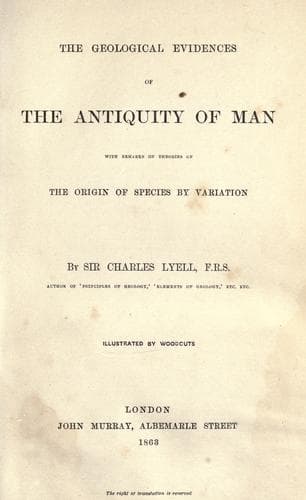
Evolution (Biology); Glacial epoch; Human beings -- Origin; Human evolution
Sir John F. Herschel, in his recent work on "Physical Geography," when
speaking of the open sea which is caused in part of the polar regions
by the escape of ice through Behring's Straits, and the flow of warmer
water northwards through the same channel, observes that these straits,
by which the continents of Asia and North America are now parted, "are
only thirty miles broad where narrowest and only twenty-five fathoms
in their greatest depth." But "this narrow channel," he adds, "is yet
important in the economy of nature, inasmuch as it allows a portion
of the circulating water from a warmer region to find its way into the
polar basin, aiding thereby not only to mitigate the extreme rigour of
the polar cold, but to prevent in all probability a continual accretion
of ice, which else might rise to a mountainous height."*
(* Herschel's "Physical Geography" page 41 1861.)
Behring's Straits, here alluded to, happen to agree singularly in width
and depth with the Straits of Dover, the difference in depth not being
more than 3 or 4 feet; so that at the rate of upheaval, which is now
going on in many parts of Scandinavia, of 2 1/2 feet in a century, such
straits might be closed in 3000 years, and a vast accumulation of ice to
the northward commence forthwith.
But, on the other hand, although such an accumulation might spread
its refrigerating influence for many miles southwards beyond the new
barrier, the warm current which now penetrates through the straits, and
which at other times is chilled by floating ice issuing from them, would
when totally excluded from all communication with the icy sea have its
temperature raised and its course altered, so that the climate of some
other area must immediately begin to improve.
There is still another probable cause of a vast change in the
temperature of central Europe in comparatively modern times, to which no
allusion has yet been made; namely, the conversion of the great
desert of the Sahara from sea into land since the commencement of
the Pleistocene period. When that vast region was still submerged, no
sirocco blowing for days in succession carried its hot blasts from a
wide expanse of burning sand across the Mediterranean. The south winds
were comparatively cool, allowing the snows of the Alps to augment to an
extent which the colossal dimensions of the moraines of extinct glaciers
can alone enable us to estimate.
The scope and limits of this volume forbid my pursuing these
speculations and reasonings farther; but I trust I have said enough
to show that the monuments of the glacial period, when more thoroughly
investigated, will do much towards expanding our views as to the
antiquity of the fauna and flora now contemporary with Man, and will
therefore enable us the better to determine the time at which Man began
in the northern hemisphere to form part of the existing fauna. [37]
CHAPTER 19. -- RECAPITULATION OF GEOLOGICAL PROOFS OF MAN'S ANTIQUITY.
Public-domain text, read in full here on John Shaqi.
Reviews
Reviews
No reviews yet
Be the first to share your thoughts on this work.
Elsewhere in the archive
Join the Discussion
Join the discussion
Sign in to leave a comment or review.
Sign InorCreate an account